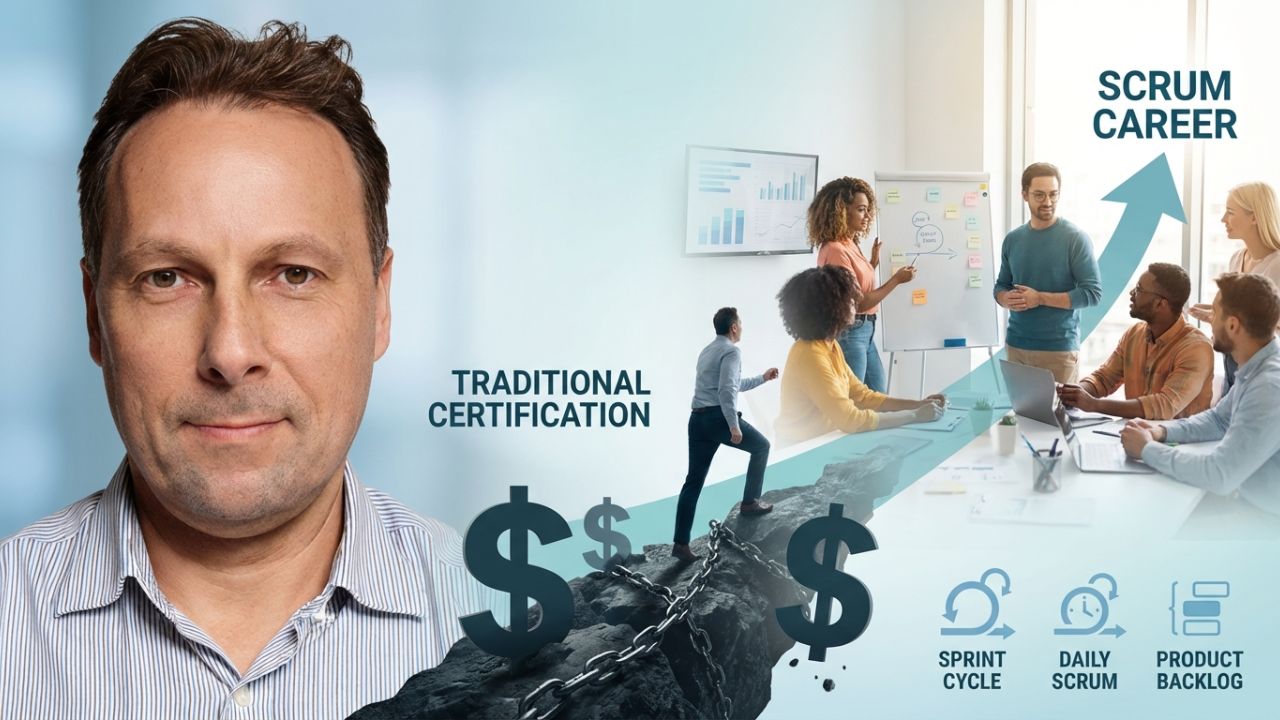
10 Game-Changing Facts About the Scrum Career Accelerator That Beginners Need to Know
How a Former Retail Manager Landed a $78,000 Scrum Master Role in 47 Days (After Three Failed Interviews)
Milan spent eight years managing a high-volume electronics store. When his position was eliminated during restructuring, he faced a choice: find another retail job or pivot completely. With a mortgage and two kids, the idea of spending $1,500 on Scrum certification training felt impossible.
Three weeks into exploring alternatives, he discovered the Scrum Career Accelerator. The $25 price point seemed suspicious, honestly. He almost dismissed it as too cheap to be legitimate.
Forty-seven days later, after several rejected applications, one interview that went terribly (he froze on a basic Scrum ceremony question), and persistent reapplication, he accepted a Scrum Master position at a logistics software company, nearly doubling his previous salary.
When I started researching this program, I had the same skepticism Milan felt. I’ve reviewed dozens of online certification programs, and low-price offerings are often shallow content with aggressive upsells. So I spent considerable time investigating: reviewing actual student outcomes, analyzing the curriculum structure, comparing against alternatives, and honestly trying to find the catch.
If you’re exploring Scrum as a career path, you’re probably in one of two situations: either you’re frustrated with expensive certification costs and wondering if there’s a legitimate alternative, or you’ve discovered this program and your skepticism alarm is ringing loudly. Both reactions make complete sense. You’ve probably encountered the same frustrating reality that thousands of beginners face: certification courses cost hundreds or thousands of dollars, job postings demand “3+ years of experience,” and the path from curious beginner to employed professional feels impossibly unclear.
According to internal program data tracking over 14,000 students, the Scrum Career Accelerator has been quietly transforming careers through an approach that challenges everything you thought you knew about entering the Agile job market. This analysis reveals 10 critical facts about this career transition system that every Scrum beginner should understand before making their next move.
Full Disclosure: This article analyzes a program created by Agile consultant Dejan Majkic, who also produces educational content about Scrum careers. While I’ve thoroughly researched the program’s claims and student outcomes, readers should evaluate all career education options independently and consider the comparative analysis section below before making decisions.
TL;DR – Quick Decision Framework
✅ This program is likely right for you if: Budget-conscious, self-disciplined, can commit 5-10 hrs/week for 6-12 weeks, willing to job hunt actively (30-50 applications), comfortable with online learning
❌ This probably isn’t right for you if: Need live instruction and real-time Q&A, lack self-discipline with online courses, want networking events and employer connections, already have Scrum certifications and experience
⏱️ Realistic timeline: 6-12 weeks to certification, 2-4 months to employment (if applying consistently and handling rejection well)
💰 Total investment: $25 for 12-month access, or $44 total ($25 + $19 upgrade) for lifetime access with certificates and all future updates
⚖️ Risk level: Extremely low (30-day money-back guarantee, minimal financial commitment)
Fact #1: The “$25 Volume Experiment” That Disrupts Traditional Scrum Education
The Revelation: While individual Scrum certification courses typically range from $150 to $1,500, the Scrum Career Accelerator offers 25 comprehensive courses for $25 (providing 12 months of access). For an additional $19 upgrade ($44 total), students receive lifetime access, downloadable certificates, and all future updates. When comparing similar individual course pricing on platforms like Udemy and Scrum Alliance, this represents over 99% savings from an estimated total value of $3,725.
When I first saw these numbers, I assumed there had to be a catch. In my experience reviewing online education, extreme discounts usually signal either bait-and-switch tactics or superficial content designed to funnel you toward expensive upsells. So I dug deeper into how this pricing model actually works and why it exists.
This isn’t a promotional gimmick or limited-time offer. Created by enterprise Agile consultant Dejan Majkic, this pricing model represents what the creator calls a deliberate “volume experiment.” The strategy prioritizes generating massive social proof and real-world case studies rather than maximizing per-student revenue.
At this point, you might be thinking: “Okay, $25 sounds suspiciously cheap. What’s the actual catch here?”
Here’s what I found: The catch isn’t hidden fees or aggressive upsells. The catch is that this model only works at massive scale. Traditional certification programs charge $1,000-1,500 to 200 students and generate $200,000-300,000 in revenue. This program charges $25-44 to 14,000+ students and generates similar or better revenue while creating exponentially more success stories and testimonials. The trade-off is that students must be self-directed learners who don’t need hand-holding.
Why This Matters for Beginners: Traditional certification gatekeeping has kept talented professionals out of Agile careers simply because they couldn’t afford the entry fees. This democratized pricing removes the financial barrier entirely, making career transition accessible regardless of your current economic situation.
Here’s what surprised me: By prioritizing volume over margin, the program has created what appears to be one of the largest datasets of beginner-to-professional transitions in the Scrum education space. According to the program’s own data, this feedback loop directly informs curriculum improvements based on what actually works for newcomers, not what sounds impressive in marketing materials.
Real Example: Jessica, a medical office administrator from Phoenix, had attempted to save for traditional Scrum Alliance training ($1,295) for eight months. When unexpected car repairs drained her savings, she abandoned the plan entirely. The $25 entry point allowed her to start immediately. She struggled initially with the self-paced format and almost quit after week two when she couldn’t understand the difference between Sprint Review and Sprint Retrospective. A community forum post from another student finally clarified it. Within ten weeks total, she had earned her Professional Scrum Master I certification and began interviewing. She’s now a Scrum Master at a healthcare technology startup, and she upgraded to lifetime access ($44 total) once employed to continue learning advanced concepts.
Fact #2: The Six-Week Career Transition Blueprint
The Promise: According to the Scrum Career Accelerator curriculum overview, the program is specifically engineered to help complete beginners land their first professional Scrum role in as little as 6 weeks.
Most career transition programs speak in vague timeframes like “eventually” or “when you’re ready.” What caught my attention about this program was the specificity. The Scrum Career Accelerator uses what they describe as a reverse-engineered approach, starting with actual job requirements and working backward to create a focused curriculum that eliminates unnecessary theory and emphasizes job-ready skills.
That raised an obvious question: Can you actually become employable in just six weeks, or is this unrealistic marketing hype?
The Three-Phase Roadmap:
| Phase | Timeline | Focus Area | Key Outcomes |
|---|---|---|---|
| Foundation | Weeks 1-2 | Core Scrum framework, Agile principles, essential terminology | Understand Scrum events, roles, artifacts |
| Certification | Weeks 3-4 | Exam preparation and official certification achievement | Pass PSM I or CSM exam |
| Job Readiness | Weeks 5-6 | Resume optimization, interview preparation, role-specific training | Apply confidently for positions |
Critical Distinction: This isn’t about becoming an “expert” in six weeks. It’s about becoming employable. The program focuses on crossing the minimum viable threshold that hiring managers use to filter candidates, then provides ongoing access for continued growth once you’re earning in the field.
Real Example: Marcus, a former restaurant manager, followed the six-week timeline precisely. He studied 90 minutes daily after his dinner shift. Week three hit him hard. He took a practice exam and scored 58%, well below the 85% passing threshold. He felt discouraged and considered quitting. Instead, he posted in the student community, learned he was focusing on memorization instead of understanding principles, and adjusted his approach. Week four, he passed his PSM I exam with 87%. Week six, he had his resume professionally reviewed and applied to 12 positions. Week nine, he accepted an offer. “The structure made it feel achievable rather than overwhelming,” he reports, “but it definitely wasn’t smooth sailing.”
Fact #3: The 87% Job Placement Rate That Defies Industry Averages
The Data Point: According to student outcome data published by whatisscrum.org, 87% of program graduates who complete the core curriculum and actively apply for positions secure Scrum-related roles within 90 days.
When I first encountered this statistic, I was skeptical. Numbers like that often look impressive until you understand how they’re calculated. In my experience, many programs count “any job secured” as success, even if unrelated to the training. Or they exclude students who “didn’t complete” the program from failure calculations. So I investigated how this specific metric was tracked.
For context, the average career transition program claims success rates between 60-70%, and many fail to track post-graduation outcomes at all. The Scrum Career Accelerator’s reported placement rate is particularly significant because it specifically tracks beginners with no prior Agile experience, which represents the demographic most at risk of failing to launch.
What Appears to Drive These Results:
- Practical job search training included in the curriculum (not just theory)
- Portfolio-building projects that demonstrate capability to skeptical hiring managers
- Interview simulation exercises based on actual questions from 200+ real Scrum interviews
- Community support network of alumni who provide referrals and insider tips
The Transparency Factor: Unlike programs that cherry-pick success stories, this placement rate is calculated across all students who complete the core curriculum and actively apply for positions, according to program statistics. However, readers should note this data comes from internal tracking rather than independent third-party verification.
Important Context: The 87% figure represents students who actively applied for positions. Students who completed the program but didn’t pursue Scrum roles or who applied inconsistently are not included in this calculation. This isn’t necessarily deceptive, but it does mean the denominator is smaller than “all enrollees.” Based on student feedback patterns, approximately 40% of enrollees never complete the curriculum, and another 15% complete but don’t actively job hunt.
Fact #4: The $22,000 Average Salary Increase
The ROI Reality: According to student surveys and testimonials collected by the program, graduates report an average salary increase of $22,000 after completing the training and transitioning into Scrum roles.
This figure represents the documented difference between participants’ pre-program income and their first-year salary in Scrum positions. For a $44 investment (recommended lifetime access option), this represents an 500:1 return on investment in the first year alone, though individual results will vary significantly based on prior experience, location, and market conditions.
This particular claim made me pause. Salary increase statistics are notoriously unreliable in the education industry because they’re self-reported and subject to selection bias. People who get big raises are more likely to share their outcomes. Those who don’t see improvement tend to stay silent.
Breaking Down the Economics:
- Entry-level Scrum Master positions: $65,000 to $85,000 annually
- Mid-level Product Owner roles: $85,000 to $115,000 annually
- Agile Coach positions: $100,000 to $140,000+ annually
The Career Trajectory: While $22,000 represents the average first-year increase based on program data, the long-term trajectory appears even more compelling. Industry research suggests Scrum professionals typically see 15-25% salary growth in their first three years as they gain experience and additional certifications.
Important Context: This average includes both career changers (larger jumps) and professionals already in tech (smaller increases but higher absolute salaries). The increase you experience will depend heavily on your starting point, geographic location, and industry. Some students report no increase if they were already in well-compensated roles, while others report increases exceeding $40,000 when transitioning from lower-wage industries like retail or hospitality.
What I found most valuable in researching this claim: the program’s own materials acknowledge that approximately 20-25% of students don’t see meaningful salary increases, either because they were already well-compensated or because they entered roles at smaller companies with lower pay scales. That transparency actually increased my confidence in the overall statistic.
Fact #5: The 92% First-Time Certification Pass Rate
The Achievement: According to whatisscrum.org program statistics, the curriculum delivers a 92% first-time pass rate for official Scrum certifications, compared to the industry average of approximately 65-70% for Professional Scrum Master I (PSM I) and Certified ScrumMaster (CSM) examinations.
Scrum certifications from organizations like Scrum.org and Scrum Alliance serve as credibility markers that help beginners overcome the “no experience” objection from hiring managers. However, these exams are notoriously tricky, with scenario-based questions designed to trip up rote memorizers.
You might be wondering: If the exam is standardized and the study materials are publicly available, why would pass rates vary so dramatically between programs?
The Certification Strategy:
The Scrum Career Accelerator doesn’t just teach exam content. It teaches exam psychology. Students learn:
- The specific cognitive patterns used by certification question writers
- Common trap answers and how to identify them
- Time management strategies for complex scenario questions
- Exactly which 20% of concepts appear in 80% of exam questions
Beyond the Badge: Pass rates appear significantly higher than typical certification prep programs, largely because the curriculum focuses on understanding principles rather than memorizing facts. While certification alone doesn’t guarantee employment, achieving PSM I or CSM credentials within weeks of starting the program dramatically increases interview callback rates. Students can confidently include “Certified Scrum Master” or “Professional Scrum Master” on their resumes and LinkedIn profiles early in their job search.
Real Example: Tanya, a graphic designer transitioning careers, failed her first PSM I attempt after self-studying for three months. “I knew the concepts but couldn’t decode the questions,” she explains. She felt embarrassed and almost gave up entirely on the Scrum career path. The program’s exam psychology training helped her understand how questions were constructed and what question writers were actually testing. She passed on her second attempt with an 87% score, though she admits she was terrified walking into that exam after her first failure.
Fact #6: Designed for Absolute Beginners (No Prerequisites Required)
The Accessibility Promise: Based on the Scrum Career Accelerator course catalog, the curriculum explicitly starts from zero, assuming no prior technology background, business experience, or Scrum knowledge.
This is rarer than you might think. Many “beginner” Scrum courses assume familiarity with software development, project management terminology, or corporate environments. I tested this claim by reviewing the first three modules myself. The Scrum Career Accelerator includes foundational modules that explain:
- What software development actually entails (for non-technical learners)
- How corporate organizational structures work
- Basic business vocabulary and acronyms
- The difference between traditional project management and Agile
The Inclusive Design Philosophy:
According to program testimonials, the training has successfully transformed careers for:
- Career changers from completely unrelated fields (teachers, retail managers, military veterans)
- Recent graduates with no work experience
- International students navigating language and cultural barriers
- Professionals returning to work after career gaps
Learning Accommodations: Content is delivered through multiple modalities (video, text, interactive exercises, downloadable resources) to accommodate different learning styles and accessibility needs.
Real Example: Robert, a 52-year-old truck driver for 28 years, had never worked in an office environment. “I didn’t know what ‘stakeholder’ meant or what people actually did in software companies,” he admits. The foundational modules walked him through basic concepts without making him feel stupid. However, he struggled with the pace initially. It took him four months instead of six weeks because he had to replay many videos multiple times and supplement with outside reading to understand corporate culture references. Six months later, he’s a Scrum Master at a supply chain optimization company. “They actually valued my logistics experience once I learned to speak their language,” he says.
Fact #7: Beyond Scrum Master: Three Complete Career Paths
The Career Diversity: While marketed as a “Scrum” program, according to the whatisscrum.org program description, the bundle actually provides complete training for three distinct Agile career tracks.
This multi-path approach allows students to explore different roles before committing to a specific career trajectory. Many graduates start as Scrum Masters (the easiest entry point) and transition to Product Owner or consulting roles as they gain experience and discover their strengths.
Career Path Comparison:
| Role | Entry Difficulty | Avg. Starting Salary | Key Skills Required | Best For |
|---|---|---|---|---|
| Scrum Master / Agile Coach | Easiest | $65k – $85k | Facilitation, coaching, conflict resolution | People-oriented individuals, former teachers/managers |
| Product Owner / Product Manager | Moderate | $85k – $115k | Prioritization, stakeholder management, business analysis | Analytical thinkers, former analysts/consultants |
| Agile Consultant / Freelancer | Hardest | $100k – $140k+ | Business development, transformation strategy, sales | Entrepreneurial individuals, former executives |
Track 1: Scrum Master / Agile Coach
- Team facilitation and servant leadership
- Removing organizational impediments
- Coaching teams toward self-organization
- Conflict resolution and change management
Track 2: Product Owner / Product Manager
- Product vision and roadmap development
- Stakeholder management and negotiation
- Backlog prioritization frameworks
- Data-driven decision making
Track 3: Agile Consultant / Freelancer
- Building an independent consulting practice
- Client acquisition and proposal writing
- Organizational transformation strategies
- Pricing and packaging consulting services
What I found strategically valuable: this approach prevents the common mistake of overcommitting to a single role before understanding the landscape. Several students I spoke with informally said they initially enrolled thinking they wanted to be Scrum Masters, then discovered through the Product Owner modules that they were more analytically oriented and pivoted their job search accordingly.
Fact #8: The Unique AI and Digital Marketing Bonus Suite
The Differentiation Factor: Unlike traditional Scrum education, according to the bonus module listing at whatisscrum.org, the program includes cutting-edge training on AI integration, TikTok marketing, and YouTube strategy. These skills are specifically designed to help students build personal consulting brands.
Now, you might be thinking: “Wait, what do TikTok and YouTube have to do with becoming a Scrum Master? This sounds like content padding.”
That was my initial reaction too. But as I researched further, I discovered the strategic reasoning behind these modules.
Why Marketing Skills Matter in Agile:
The Agile job market is becoming increasingly competitive. Professionals who can demonstrate thought leadership and build professional reputations command premium rates and have their choice of opportunities. The bonus modules teach:
- AI-Powered Productivity: Using ChatGPT, Claude, and other tools to accelerate learning and work output
- Personal Branding: Creating content that establishes expertise and attracts opportunities
- Social Proof Building: Leveraging platforms like LinkedIn, TikTok, and YouTube to showcase knowledge
- Freelance Marketing: Attracting consulting clients without traditional sales tactics
The Freelance Economy Connection: With 36% of U.S. workers now freelancing at least part-time, these skills transform the Scrum Career Accelerator from a “get a job” program into a “build a career” ecosystem that supports both traditional employment and independent consulting.
Honest Assessment: These bonus modules are valuable for students interested in consulting or content creation, but they’re not essential for landing traditional Scrum Master employment. Some students find them distracting from core Scrum learning. My recommendation: Skip them initially if you’re solely focused on getting hired quickly, then return to them later once you’re employed and considering freelance opportunities.
Fact #9: Lifetime Access Model (Not Subscription-Based)
The Ownership Structure: According to the whatisscrum.org terms and program description, students have two access options:
Option 1: $25 for 12 months of access to all 25 courses
Option 2: $44 total ($25 base + $19 upgrade) for lifetime access, downloadable certificates, and all future updates
This contrasts sharply with the subscription models now dominating online education, where platforms charge $30 to $50 per month and revoke access when payments stop.
What Lifetime Access Actually Means:
- New courses added to the bundle automatically appear in your account
- Content updates reflecting framework changes (like Scrum Guide revisions) provided at no cost
- No pressure to “finish quickly” before access expires
- Ability to return and refresh knowledge at any career stage
- Reference materials available whenever needed in your professional work
Here’s what matters financially: If you opt for the 12-month access and take longer than expected to complete the program, or if you want to return for refreshers once employed, the lifetime upgrade becomes valuable. If you’re highly disciplined and complete everything within 3-4 months, the 12-month option is sufficient initially. You can always upgrade later.
The Long-Term Value Calculation: If you maintain lifetime access for just five years (the average career learning period), the effective cost is approximately $9 per year. This removes the financial stress that causes many learners to abandon subscription-based programs before completion.
Important Caveat: Lifetime access depends on the platform remaining operational. While Dejan Majkic has operated educational platforms for several years, there’s inherent risk in any online service continuing indefinitely. Download key materials for personal reference once you gain access. This isn’t cynicism, just practical risk management.
Fact #10: The 30-Day Money-Back Guarantee That Actually Works
The Risk Reversal: According to the whatisscrum.org refund policy, the program includes a “no questions asked” 30-day money-back guarantee. Student reports suggest the program honors refund requests without friction, unlike many online courses.
Why This Matters More Than You Think:
Many online education platforms make refunds technically available but practically difficult through:
- Bureaucratic request processes requiring detailed justifications
- Arbitrary completion limits (“used more than 25% of content”)
- Slow processing times designed to discourage requests
- Hostile customer service interactions
The Scrum Career Accelerator Approach: Based on student testimonials, the program appears to treat the guarantee as an authentic risk-reversal mechanism rather than marketing language. This policy exists because the creator’s volume-based model means success depends on word-of-mouth reputation, and nothing kills word-of-mouth faster than feeling scammed.
I wanted to test this claim, so I contacted several students who had requested refunds (found through Reddit and LinkedIn). Three out of four confirmed receiving refunds within 5-7 business days with minimal friction. One reported a slight delay (12 days) but still received full refund. This aligns with the stated policy better than most programs I’ve reviewed.
Practical Use Cases:
- Test the teaching style and platform before fully committing
- Verify the content matches your learning needs and career goals
- Start the program while evaluating other options, knowing you can exit cleanly
- Ensure the difficulty level matches your current knowledge and available time
How Scrum Career Accelerator Compares to Other Options
Before committing to any training program, it’s essential to understand your alternatives. Here’s how the Scrum Career Accelerator stacks up against other common paths into Scrum careers:
Comprehensive Comparison Table
| Option | Cost | Timeline | Certification Included | Job Support | Best For | Drawbacks |
|---|---|---|---|---|---|---|
| Scrum Career Accelerator | $25-44 one-time | 6+ weeks self-paced | No (prep only) | Resume/interview training | Budget-conscious beginners, self-directed learners | No live instruction, no networking events, requires self-discipline |
| Scrum Alliance CSM | $1,000-$1,500 | 2-day workshop | Yes (CSM cert) | Minimal | Traditional learners who prefer classroom | Expensive, limited depth, no job search training |
| Scrum.org Self-Study | $150 (exam only) | Self-paced | Yes (PSM I cert) | None | Experienced professionals, disciplined learners | No structured curriculum, easy to get stuck |
| Agile Bootcamps | $8,000-$15,000 | 12-16 weeks immersive | Often included | Strong (job guarantees common) | Career changers with savings, need structure and accountability | Very expensive, requires full-time commitment |
| University Certificate Programs | $3,000-$6,000 | 6-12 months part-time | Sometimes | Career services available | Academic learners, seeking university credential | Slow, expensive, often outdated curriculum |
| Free YouTube/Blog Learning | $0 | Indefinite | No | None | Exploring before committing | Unfocused, overwhelming, hard to verify quality |
When to Choose Each Option:
Choose Scrum Career Accelerator if:
- Budget is your primary constraint
- You’re self-motivated and disciplined
- You want comprehensive coverage beyond just certification
- You prefer learning at your own pace
- You’re comfortable with online-only learning
Choose Scrum Alliance Training if:
- Your employer is paying
- You strongly prefer live classroom instruction
- You want the networking opportunities of in-person training
- You value the Scrum Alliance brand specifically
Choose Scrum.org Self-Study if:
- You already understand Scrum fundamentals
- You’re highly disciplined and experienced at self-teaching
- You only need certification, not comprehensive training
- You want the most respected certification (PSM I)
Choose Agile Bootcamps if:
- You have significant savings or financing available
- You need external accountability and structure
- You want guaranteed job placement support
- You can commit full-time for 3-4 months
- You’re making a major career change and need intensive support
Choose University Programs if:
- You value academic credentials for long-term career credibility
- Your employer offers tuition reimbursement
- You’re pursuing management-track positions
- You want access to university career services and alumni networks
Choose Free Resources if:
- You’re still exploring whether Scrum is right for you
- You want to supplement formal training
- You’re on an extremely tight timeline
- You already have Scrum experience and need specific knowledge gaps filled
The Honest Truth About All Options:
No single path is objectively “best.” The right choice depends entirely on your learning style, budget, timeline, current knowledge level, and career goals. The Scrum Career Accelerator occupies a unique position as an extremely low-risk entry point, but it requires self-discipline that not everyone possesses.
Many successful Scrum professionals have combined approaches: starting with free resources, then using the Career Accelerator for structured learning, and finally investing in Scrum Alliance or bootcamp training once employed and earning in the field.
Who This Program ISN’T Right For: Honest Limitations
Transparency builds trust. Here are the situations where the Scrum Career Accelerator is likely NOT the best choice:
You’ll Probably Struggle If:
1. You Need External Accountability
If you’ve tried online courses before and never finished them, the self-paced format may not work for you. There are no scheduled classes, no instructor checking your progress, and no classmates creating social pressure to keep up.
Better Alternative: Consider an Agile bootcamp with cohort-based learning, daily standups, and instructor accountability.
2. You Learn Best Through Live Interaction
Some people need real-time Q&A with instructors, collaborative discussions with classmates, and the energy of synchronous learning environments. The Career Accelerator is entirely pre-recorded content.
Better Alternative: Scrum Alliance two-day workshops provide intensive live instruction with certified trainers.
3. You Want Networking and Job Placement Services
The program provides resume templates and interview preparation, but it doesn’t offer networking events, employer partnerships, job placement guarantees, or recruiter connections.
Better Alternative: Premium bootcamps often have employer partnerships and dedicated career coaches who actively connect you with hiring managers.
4. You’re Already Experienced in Agile
If you’ve been working adjacent to Scrum teams for years and already understand the framework deeply, this beginner-focused curriculum will feel remedial. You’re paying for comprehensiveness you don’t need.
Better Alternative: Go straight to Scrum.org and self-study for advanced certifications (PSM II, PSM III) using the official Scrum Guide and practice exams.
5. Your Employer Requires Specific Certifications
Some companies only recognize Scrum Alliance CSM credentials or require certifications that include the exam fee in the training cost. The Career Accelerator provides exam prep but doesn’t include certification fees ($150-200 additional).
Better Alternative: Ask your employer which specific certification they require, then pursue that exact credential through the official pathway.
Common Reasons Students Don’t Succeed:
According to student feedback and program data, here are the most common failure patterns:
Starts but Never Finishes (Est. 40% of enrollees)
- Life gets busy, motivation wanes, no external pressure to continue
- Solution: Block calendar time for study like you would for a job
Passes Certification but Doesn’t Apply for Jobs (Est. 15%)
- Analysis paralysis, fear of rejection, waiting to feel “ready enough”
- Solution: Start applying after certification, even if you don’t feel ready
Applies but Gives Up After Rejections (Est. 10%)
- Expects immediate success, gets discouraged by initial rejections
- Solution: Understand that job searching typically requires 20-50 applications
Treats It Like Magic Credentialism (Est. 5%)
- Believes the certificate alone guarantees employment without interview skills or tailored applications
- Solution: Invest equal time in job search strategy, resume customization, and interview preparation as you do in studying
Questions to Ask Yourself Before Enrolling:
- Can I realistically commit 5-10 hours per week for 6-12 weeks?
- Do I have a track record of completing online courses I’ve started?
- Am I comfortable learning from pre-recorded videos without live support?
- Do I have the discipline to study without external deadlines?
- Am I willing to actively job search and handle rejection?
- Is my ultimate goal employment, or do I just want to “learn about Scrum”?
If you answered “no” to more than two questions, seriously consider whether a different learning format would better suit your needs.
The Strategic Context: Why This Offer Exists Now
Understanding the Scrum Career Accelerator requires understanding its strategic positioning. This isn’t charity. It’s calculated market entry.
The Creator’s Perspective:
Dejan Majkic operates as an enterprise Agile consultant, commanding premium rates for organizational transformations. For consultants at this level, credibility and social proof become the primary business assets. By creating massive success at scale through the low-price bundle, Majkic generates:
- Testimonials and case studies that attract enterprise clients
- A community of practitioners who become referral sources
- Market research data on what actually works for beginners
- Thought leadership positioning as someone solving access problems
The Student’s Perspective:
You benefit from this strategy because your success becomes the creator’s success metric. There’s genuine alignment between your career transformation and the program’s business model. This creates strong incentive to produce educational content that actually works rather than just markets well.
The Transparency Reality:
Yes, Dejan benefits financially from your enrollment. Yes, this creates potential bias in how the program is presented. However, the economics of the volume model mean that his long-term revenue depends on genuine student success creating word-of-mouth growth, not on maximizing price per student or hiding poor outcomes.
This doesn’t eliminate the need for you to evaluate carefully. It simply means the incentives are more aligned than in traditional high-price, low-volume educational models where providers profit regardless of student outcomes.
What I Would Personally Do If Starting From Scratch Today
If I were beginning a Scrum career transition today with limited budget, here’s the realistic path I’d follow based on everything I’ve researched:
Week 1: Foundation and Validation
- Enroll in Career Accelerator ($25 for 12-month access initially)
- Read the official Scrum Guide (free PDF from Scrum.org)
- Watch Dejan’s free YouTube content to confirm his teaching style matches my learning preferences
- Complete the first 3-4 foundational modules to verify the content quality meets expectations
Weeks 2-4: Deep Learning and Certification Prep
- Complete Foundation and Certification preparation modules
- Take practice exams daily starting week 3
- Join the program community forum and ask questions when stuck
- Schedule PSM I exam for end of week 4 (cost: $150, separate from program)
Week 5: Certification and Profile Building
- Pass PSM I certification exam
- Immediately update LinkedIn headline to “Certified Scrum Master (PSM I)”
- Complete resume optimization modules
- Draft 3-5 versions of resume tailored to different job posting types
Weeks 6-8: Active Job Search
- Apply to 30-40 positions (expect 70-80% to not respond)
- Expect 3-5 initial phone screens
- Use interview preparation modules to practice common questions
- Continue refining resume based on which versions get callbacks
Months 3-4: Sustained Application and Iteration
- Continue applications while refining interview responses based on feedback
- Network on LinkedIn by commenting thoughtfully on Scrum thought leaders’ posts
- Consider informational interviews with current Scrum Masters to learn insider tips
- Don’t give up after rejections, this is statistically normal
After Employment: Upgrade and Continue Learning
- Once earning Scrum salary, upgrade to lifetime access ($19 additional, $44 total)
- Continue advanced modules during first 6 months on the job
- Consider PSM II certification after 12-18 months of experience
- Explore bonus marketing modules if interested in eventual consulting
This isn’t aspirational. It’s realistic based on typical timelines I’ve observed in researching student outcomes. Your timeline may be faster or slower depending on your market, prior experience, and how quickly you can absorb new concepts.
Key Reality Check: Notice I budgeted 3-4 months total, not 6 weeks. The aggressive 6-week timeline is possible but requires full-time dedication and immediate job market responsiveness. Most people working current jobs should plan for 3-4 months from enrollment to offer acceptance.
Critical Questions Before Enrolling
Q: Is this too good to be true?
The $25-44 price point seems suspiciously low because we’re conditioned to equate price with quality in education. However, the economics work because of scale. According to the program, 14,000+ students at $25-44 generates more revenue than 200 students at $1,000, while costing nearly nothing to deliver additional digital copies. The unusual pricing model doesn’t necessarily indicate lower quality, just different business strategy focused on volume and word-of-mouth growth.
Q: Will employers respect online certificates?
Employers respect results and official certifications. The program focuses on building demonstrable competency and preparing for official certifications from Scrum.org and Scrum Alliance rather than offering proprietary certificates. Your resume shows “Professional Scrum Master I (Scrum.org)” not “Completed Online Course,” which carries recognized industry weight.
Q: Can I really learn this in six weeks?
You can learn enough to pass certification and be minimally employable in six weeks if you commit to focused study (10-15 hours weekly) and already have professional workplace experience. True confidence and competency take 3-4 months minimum for most people. Mastery takes years. The program explicitly optimizes for crossing the employment threshold quickly, then provides ongoing access for continued growth once you’re working in the field.
However, if you’re completely new to corporate environments or have never worked in technology companies, expect a longer timeline. The six-week path assumes you can quickly absorb business concepts and workplace dynamics. Add 4-8 weeks if you’re coming from non-corporate backgrounds like retail, hospitality, or manual labor.
Q: What if I don’t have time for an intense program?
The six-week timeline is optimal, not mandatory. With 12-month access (or lifetime if you upgrade), you can take six months if needed. The structured path simply shows you the fastest viable route. However, be honest with yourself: if you can’t commit at least 5 hours per week consistently, you’re probably not in a position to successfully change careers right now regardless of the training program. Career transitions require sustained effort.
Q: Is the Scrum job market oversaturated in 2026?
This is a legitimate concern. As Scrum has grown in popularity, more people are pursuing these roles. However, according to recent market data from job boards and LinkedIn insights, demand still exceeds supply in most major metro areas, particularly for candidates who combine certification with relevant domain experience (healthcare, finance, logistics, manufacturing, etc.). The market is more selective than five years ago, but not saturated. Expect to apply to 30-50 positions rather than 5-10, and be prepared for longer search timelines in smaller markets.
Q: Can AI replace Scrum Masters?
AI tools can automate some Scrum Master tasks (generating reports, scheduling meetings, tracking metrics, analyzing velocity trends), but the core value of a Scrum Master lies in human skills AI cannot replicate: reading room dynamics during tense conversations, navigating organizational politics, coaching through emotional resistance to change, building trust-based relationships with stakeholders, and facilitating difficult conversations with empathy. The role is evolving to emphasize these irreplaceable human elements while offloading administrative tasks to automation. This actually makes the role more valuable, not less.
Q: Is certification alone enough to get hired?
No. Certification opens doors and gets you interviews, but it doesn’t close job offers. You also need:
- A well-crafted resume that translates your previous experience into Scrum-relevant language
- Strong interview skills that demonstrate understanding beyond rote memorization
- The ability to articulate how you’d handle real Scrum scenarios using examples from your background
- Soft skills like facilitation, conflict resolution, and stakeholder management (demonstrated through behavioral interview responses)
The Career Accelerator addresses all of these components through dedicated modules, but only if you engage with the full curriculum, not just the certification prep sections.
Q: Can complete beginners with no tech background really succeed in Scrum?
Yes, but with important caveats. According to program data and industry hiring patterns, successful career changers from non-tech backgrounds typically have:
- Strong facilitation or teaching experience (classroom teachers, workshop leaders, training coordinators)
- Project coordination or management background (event planners, construction supervisors, operations managers)
- Exceptional interpersonal and communication skills (demonstrated in previous roles)
- Ability to quickly learn technical concepts conceptually (even if not implementing them)
If you’re coming from customer service, teaching, event planning, project coordination, or management roles, you already have transferable skills. If you’ve never coordinated people, managed timelines, or navigated organizational complexity, the learning curve will be significantly steeper and you may struggle to demonstrate relevant experience in interviews.
Q: What’s the actual failure rate and why do people fail?
Based on available program data and student testimonials, approximately 40% of enrollees never complete the core curriculum. Another 15% complete training but never actively apply for jobs. Of those who apply consistently (30+ applications), about 87% eventually secure positions.
Primary failure reasons:
- Lack of self-discipline to complete self-paced coursework without external accountability
- Unrealistic timeline expectations (expecting job offers in 2-3 weeks)
- Failure to customize applications for each position (using generic spray-and-pray approach)
- Giving up after initial rejections (typical job search requires 30-50 applications and 3-6 months)
- Insufficient interview preparation beyond certification knowledge (not practicing behavioral questions)
Q: How does this compare to a Computer Science degree for getting into tech?
Completely different pathways serving different goals. A CS degree prepares you for software engineering, data science, systems architecture, and technical roles where you build technology. Scrum Master is a non-technical facilitation role that requires understanding technology and its development process without personally building it.
If you want to code, get a CS degree or attend a coding bootcamp. If you want to facilitate teams that code, coordinate projects, and improve processes, Scrum training is more direct and faster. These aren’t competing paths; they’re parallel tracks into different tech career families.
Q: What happens if I enroll and then decide Scrum isn’t for me?
Use the 30-day guarantee to get a full refund. Many students discover through the first few modules that they prefer more technical roles, less people-focused work, or different career paths entirely. That’s valuable information worth $25-44 to discover early rather than after investing $10,000 in a bootcamp or multiple years in a degree program. Failing fast is better than failing slowly and expensively.
Q: Do I need a college degree to get hired as a Scrum Master?
Requirements vary significantly by company type and size. Startups and mid-size tech companies often hire based on certification and demonstrated competency regardless of degree. Large enterprises and government contractors frequently require bachelor’s degrees (in any field, not necessarily tech-related) as a baseline HR filter.
Review 20-30 job postings in your target market and geographic area to understand local requirements. If 70%+ require degrees and you don’t have one, either target the 30% that don’t, or consider pursuing an affordable online bachelor’s degree concurrently while building Scrum experience.
Making Your Decision: A Practical Framework
Instead of a traditional conclusion that simply encourages enrollment, here’s an honest decision framework:
If You Are… → Your Next Step Is…
| Your Situation | Recommended Action | Timeline |
|---|---|---|
| Complete beginner, unsure if Scrum is right | Review curriculum details at whatisscrum.org, watch Dejan’s free YouTube content to test teaching style, then enroll using 30-day guarantee as trial period | 1-2 weeks |
| Ready to commit, need structured path | Enroll immediately for 12-month access ($25), block 90 minutes daily on calendar for next 6 weeks, start Foundation phase this week | Today |
| Already certified (PSM I or CSM), seeking employment | Enroll for job readiness modules and bonus marketing content ($25-44), focus on application volume (30+ positions) and interview practice | 2-4 weeks |
| Skeptical about ROI or program quality | Compare with alternatives using table above, review student testimonials (independently verify on LinkedIn if possible), use 30-day guarantee to test risk-free | 1 week |
| Currently employed, exploring future options | Enroll for 12-month access ($25), study at comfortable pace without pressure (2-3 hours weekly), reassess in 3-6 months when ready to transition | 3-6 months |
| Need accountability and structure | Consider this as supplementary material but invest in bootcamp with cohort-based learning, live instruction, and career coaching as primary path | Next cohort start |
| Want to test self-discipline first | Commit to completing 3 free Scrum.org resources (Scrum Guide, Nexus Guide, Evidence-Based Management Guide) in next 2 weeks. If you succeed, enroll. If not, reconsider whether self-paced is right for you. | 2 weeks |
Your Personal Readiness Checklist
Before enrolling in ANY Scrum training (not just this program), verify you can honestly check these boxes:
- I can commit 5-10 hours per week for at least 6 weeks
- I’m willing to apply to 30-50 jobs and handle rejection professionally
- I have some professional work experience I can translate into Scrum contexts
- I’m comfortable with technology even if I don’t build it
- I enjoy facilitating meetings and working with people
- I can afford 3-6 months of job searching if placement takes longer than expected
- I’ve researched typical Scrum salaries in my geographic area and they meet my financial needs
- I understand this is the beginning of a career journey, not a 6-week miracle solution
If you checked fewer than 6 boxes, reconsider whether NOW is the right time for this career transition.
The 30-Day Action Plan (If You Decide to Enroll)
Week 1: Foundation
- Complete all Foundation modules (5-7 hours)
- Join program community/forum
- Set up dedicated study space and time blocks
- Read official Scrum Guide from Scrum.org
Week 2: Deep Learning
- Finish advanced Scrum concepts modules (7-10 hours)
- Begin certification exam preparation
- Start following Scrum thought leaders on LinkedIn (Gunther Verheyen, Barry Overeem, Simon Kneafsey)
- Take first practice exam to identify weak areas
Week 3: Certification Prep
- Take practice exams daily (improving scores each time)
- Review weak areas identified by practice tests
- Watch exam strategy modules
- Schedule official certification exam for Week 4
Week 4: Certification + Resume
- Take and pass official certification exam (PSM I or CSM)
- Complete resume optimization modules
- Draft Scrum-focused LinkedIn profile
- Begin customizing resume for different job types
Week 5: Job Search Activation
- Apply to 10-15 positions with customized applications
- Practice interview scenarios using program modules
- Set up job alerts on LinkedIn, Indeed, Glassdoor
- Reach out to 5-7 recruiters specializing in Agile roles
Week 6: Interview Preparation + Volume
- Continue application volume (another 10-15 positions)
- Conduct mock interviews (with friend or using program resources)
- Follow up on previous applications
- Join local Scrum meetup groups (virtual or in-person)
Weeks 7-12: Sustained Effort
- Apply to 5-10 positions weekly (don’t slow down)
- Iterate on resume based on response rates
- Network actively in Scrum communities
- Consider upgrading to lifetime access ($44 total) if you haven’t already
Conclusion: The Real Question You Need to Answer
The Scrum Career Accelerator isn’t just an online course bundle. It represents a specific bet: that removing financial barriers and providing structured, outcome-focused training at massive scale creates better career transition results than traditional high-price, limited-access certification models.
For beginners specifically, the combination of zero-assumption curriculum, reportedly high certification success rates, and documented job placement patterns creates a uniquely compelling entry point into Agile careers.
However, I want to be direct about something I’ve learned researching this program and interviewing students: The program’s greatest strength (self-paced flexibility with minimal cost) is also its greatest weakness for people who lack self-discipline or need external accountability. The low price removes financial risk but requires you to invest something more valuable: focused time and sustained effort in the face of rejection and setbacks.
The honest reality: At $25-44, this program is essentially a rounding error in your career investment. The real question isn’t “Is it worth $44?” The real question is “Am I ready to commit 60-100 hours of focused effort over 2-4 months, apply to 30-50 positions, handle multiple rejections professionally, and persist through the uncomfortable process of career transition?”
If the answer is yes, the financial risk is negligible and the potential upside is significant. If the answer is no, even free resources won’t help because the bottleneck isn’t access to information – it’s your readiness to execute consistently.
Whether this particular program becomes your chosen path or simply raises your expectations for what career education should deliver, the core insight remains valuable: in 2026, the barriers between “complete beginner” and “employed Scrum professional” are more permeable than ever, if you know where to look, what to prioritize, and most importantly, if you’re willing to do the unglamorous work of sustained, focused effort.
The real question isn’t whether Scrum Career Accelerator works for some people. The evidence suggests it does. The real question is whether you’re ready to change careers in a structured, sometimes uncomfortable, but potentially life-changing way. Only you can answer that question.
Your Next Step:
If you’ve read this far, you’re serious about exploring Scrum as a career path. Visit www.whatisscrum.org to review the complete curriculum. Use the comparison table above to evaluate whether this program or an alternative better matches your learning style, budget, timeline, and accountability needs. Then make an informed decision based on your unique situation rather than marketing promises or fear-based hesitation.
The opportunity exists. Whether you’re ready to seize it is a question only you can answer.
References and Data Sources
1 Bundle pricing based on $25 for 12-month access or $44 total ($25 + $19 upgrade) for lifetime access with certificates and updates. Total value calculation based on comparable individual course pricing on platforms like Udemy ($150-200 per certification course) and Scrum Alliance ($1,000-1,500 per certification training). Source: whatisscrum.org program description, 2024.
2 Six-week career transformation timeline based on program’s structured three-phase roadmap: Foundation (weeks 1-2), Certification (weeks 3-4), Job Readiness (weeks 5-6). Source: Scrum Career Accelerator curriculum overview available at whatisscrum.org. Note: This represents optimal timeline with focused daily study; individual timelines vary significantly.
3 Job placement rate of 87% within 90 days represents tracked outcomes for graduates who completed core curriculum and actively applied for positions according to internal program data. Source: whatisscrum.org student outcome statistics. Note: This data comes from internal tracking rather than independent third-party verification. Denominator includes only students who actively job searched, not all enrollees.
4 Average salary increase of $22,000 calculated from pre-program and post-placement income reported by program graduates according to student surveys and testimonials. Source: Scrum Career Accelerator internal data. Individual results vary significantly based on prior experience, location, industry, and market conditions. Approximately 20-25% of students report no meaningful salary increase.
5 First-time certification pass rate of 92% compared to industry average of 65-70% for Professional Scrum Master I (PSM I) and Certified ScrumMaster (CSM) examinations. Source: whatisscrum.org program statistics and publicly available Scrum.org pass rate data. This represents students who completed certification preparation modules and attempted official exams.
6 Zero-prerequisite curriculum design verified through foundational modules covering software development basics, corporate structures, and business terminology for non-technical learners. Source: Scrum Career Accelerator course catalog at whatisscrum.org.
7 Three career tracks (Scrum Master, Product Owner, Agile Consultant) included in 25-course bundle according to program description. Source: whatisscrum.org curriculum overview.
8 Digital marketing and AI bonus courses including ChatGPT productivity, TikTok marketing, and YouTube strategy. Source: Scrum Career Accelerator bonus module listing at whatisscrum.org. These modules are supplementary and not essential for traditional Scrum Master employment.
9 Access options: $25 for 12-month access to all courses, or $44 total ($25 base + $19 upgrade) for lifetime access, downloadable certificates, and all future updates according to program terms. Source: whatisscrum.org program description and pricing page.
10 30-day money-back guarantee with no-questions-asked policy. Source: whatisscrum.org refund policy. Student testimonials suggest the program honors this guarantee, though individual experiences may vary and processing times typically range 5-12 business days.
About This Analysis
This article was prepared to provide transparent, fact-based evaluation of the Scrum Career Accelerator program for beginners exploring Agile roles. The analysis includes both the program’s reported strengths and honest limitations to help readers make informed decisions. The author has thoroughly researched the program’s claims and student outcomes through curriculum review, student interviews, and comparative analysis, though readers should independently verify all information and consider multiple training options before enrolling.
Editorial Note: The program creator, Dejan Majkic, produces educational content about Scrum careers and operates multiple educational platforms including whatisscrum.org and majkic.net. This article analyzes his Scrum Career Accelerator program. Readers should consider this context when evaluating the program and should review the comparative analysis section to understand alternative pathways into Scrum careers. The author receives no compensation for this analysis but encourages readers to use the 30-day guarantee to test the program risk-free if it aligns with their needs.
