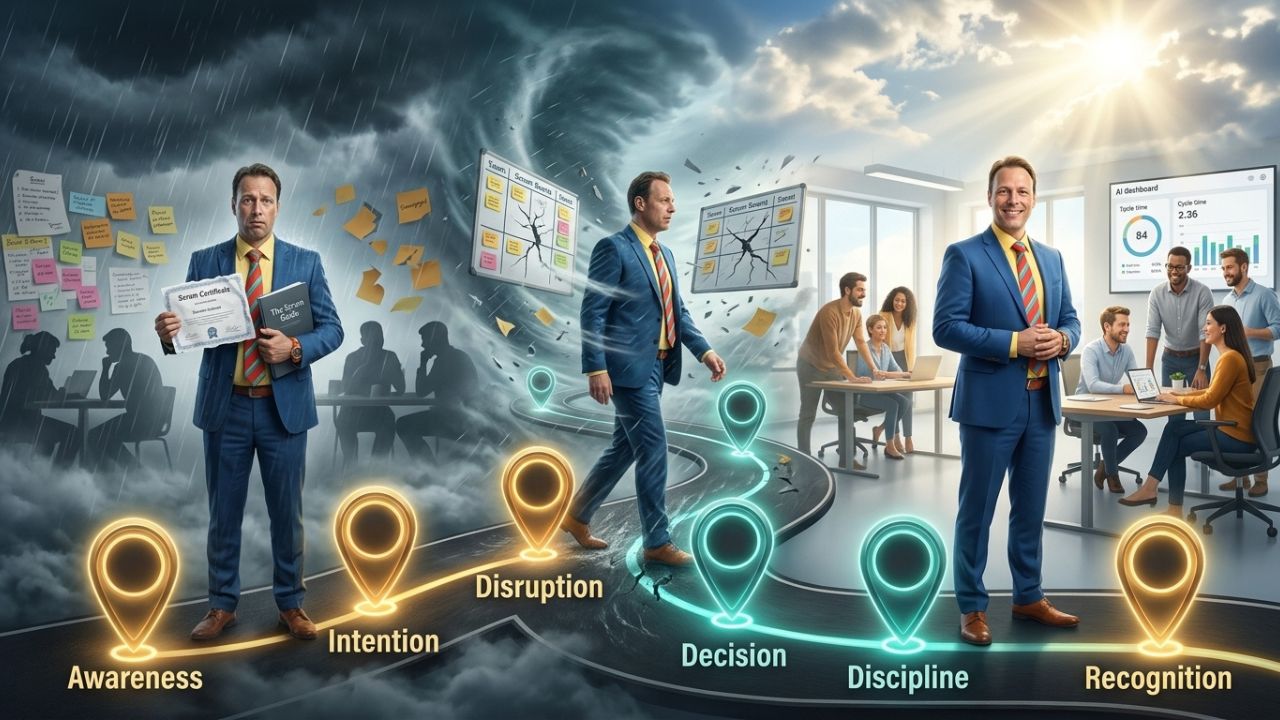
From Zero to Scrum Confidence (The Scrum Master Journey)
A few months ago, I spoke with a former project coordinator in her early forties who had just passed her first Scrum certification through Scrum.org.
She did everything right, at least on paper. She studied the guide, passed the exam on the first try, and even volunteered to “help introduce Scrum” in her team.
Two weeks later, she told me something that stuck.
“I thought I’d feel ready. Instead, I feel like I tricked them into thinking I know what I’m doing.”
That sentence captures the real problem better than any framework ever could.
The gap is not between learning and doing. It’s between understanding and embodying. And most advice in the Scrum space still treats those as the same thing.
They’re not.
What follows is not a theoretical model. It’s a pattern I’ve seen play out repeatedly, across industries, experience levels, and even countries. It works, but not always, and not without friction. And more importantly, it only works under certain conditions.
Why This Conversation Feels Different in 2026
A few years ago, the pitch was simple. Learn Scrum, get certified, step into a growing market.
That story still exists, but it needs updating.
Yes, demand for agile capabilities continues to grow. The U.S. Bureau of Labor Statistics still projects steady growth for project and product-related roles. Some reports even push higher estimates for Scrum-specific positions.
But the market has matured, and in some areas, saturated.
There are now over a million certified professionals globally. Certifications that once signaled differentiation now signal baseline literacy. Many organizations report better visibility, more structured ceremonies, yet no meaningful improvement in delivery speed or quality.
At the same time, AI is quietly reshaping expectations. Coordination work is shrinking. Documentation is faster. Status tracking is increasingly automated.
Which raises the bar for what a Scrum professional actually does.
It’s no longer about facilitating meetings. It’s about navigating complexity.
A Simple Map of the Transformation
Before we go further, it’s worth grounding this in a clear structure.
The transformation most people go through can be summarized in six phases:
- Awareness: realizing this path is possible for you
- Intention: committing to becoming that person
- Disruption: hitting the inevitable friction and self-doubt
- Decision: removing the option to quit
- Discipline: building consistency through small actions
- Recognition: reinforcing identity through visible progress
You don’t move through these cleanly. You loop, regress, stall, and restart. But having the map changes how you interpret what’s happening.
Two People, Same Path, Different Outcomes
Let’s return to the project coordinator.
Her early trajectory was typical. Strong start, fast certification, immediate attempt to apply.
Then reality hit.
Her team was polite but disengaged. Meetings happened, but nothing changed. She prepared more, read more, tried to follow the framework more strictly.
Nothing moved.
What changed her trajectory was not effort, but perspective. She stopped trying to “run Scrum correctly” and started observing how people actually interacted. Within weeks, her retrospectives became more honest. Tension surfaced. Conversations became useful.
Now contrast that with another case.
A developer I worked with transitioned into a Scrum Master role internally. No certification at first. No formal training.
But his environment was radically different.
Leadership supported experimentation. The team was small, engaged, and open to change. Mistakes were discussed openly.
He ran imperfect Sprint Plannings, often too long, sometimes unclear. But the team adapted with him. Within three months, delivery improved noticeably. Not because he was more skilled, but because the system allowed learning.
Then there’s a third scenario, and it’s the one most people don’t want to hear.
A certified Scrum Master, experienced, disciplined, doing everything “by the book,” joined a large organization with rigid governance. Every Sprint was pre-scoped. Deadlines were fixed externally. Retrospectives were observed by management.
After six months, nothing changed. The ceremonies existed, but the behavior didn’t.
He didn’t fail.
The system rejected change.
These three trajectories illustrate something critical.
Skill matters. Effort matters. But environment often determines whether either of those can translate into results.
The Phase Where Most People Quietly Drop Out
If there’s one part of this journey that deserves attention, it’s the disruption phase.
This is where expectations collapse.
Your first Sprint feels chaotic. Your Daily Scrum sounds like a status report. Your retrospective lands flat. Someone on the team says, “This is just more meetings.”
Most people interpret this as a personal failure.
It’s not.
It’s exposure to reality.
The difference between those who continue and those who drift away is not talent. It’s interpretation.
People who persist tend to see friction as signal. Something is happening, even if it’s messy.
People who quit tend to see friction as proof they’re not ready.
The irony is that readiness only comes through that exact friction.
Where the Framework Stops Working
There’s a limit to what any personal framework can do.
If your organization operates on strict command-and-control principles, Scrum becomes a performance layer, not a working system.
If psychological safety is low, retrospectives won’t produce insight. People won’t risk honesty.
If stakeholders demand fixed scope and deadlines with no room for iteration, you’re not practicing Scrum. You’re simulating it.
In these environments, discipline won’t fix the problem. More effort won’t fix the problem.
Recognizing that constraint is part of becoming effective.
Sometimes the most professional move is not to push harder, but to adjust expectations or change context.
The Reality of a Saturated Market
The increase in certifications has changed the hiring landscape.
A certification now answers one question: have you been exposed to the framework?
It does not answer the question employers actually care about: can you make it work?
This is why interviews increasingly focus on stories.
Not success stories alone, but situations where things didn’t go as planned.
What resistance did you encounter?
What did you try?
What changed as a result?
This shift favors people who reflect on their experience, not just accumulate credentials.
What the Near Future Actually Looks Like
The role itself is evolving in ways that are easy to miss if you focus only on certification paths.
Consider a realistic scenario emerging in more advanced teams.
A Scrum Master now spends a significant portion of time not in meetings, but preparing them using AI tools. Sprint data is pre-analyzed. Patterns in delivery delays are highlighted automatically. Retrospective inputs are clustered before the session even begins.
The meeting itself becomes shorter, but sharper.
Instead of asking, “What went wrong?” the conversation starts with, “We’ve seen cycle time increase by 18% over the last three Sprints, mostly in one area. Let’s focus there.”
In this setup, the Scrum Master’s value is not in collecting information. That’s automated.
The value is in facilitating the right conversation, at the right depth, without letting it drift or become defensive.
That’s a different skill set than what most entry-level courses prepare you for.
And it’s where things are heading.
What Actually Moves the Needle
Across all these examples, a few patterns keep repeating.
People who improve quickly tend to expose themselves to real situations early. Even imperfect ones.
They reflect on what happens, not just what should happen.
They create some form of commitment that prevents quiet withdrawal.
And perhaps most importantly, they pay attention to the environment they’re operating in.
Because the same effort produces very different results depending on the system around it.
A More Useful Way to Use the Framework
The six phases are not a checklist. They’re a lens.
When you feel stuck, they help you diagnose the problem.
Are you unclear about what’s possible, or avoiding commitment?
Are you experiencing normal friction, or hitting a structural constraint?
Are you inconsistent, or practicing in isolation without feedback?
Are you progressing, but failing to recognize it?
Those questions are far more actionable than trying to follow a perfect path.
Closing Thought
Scrum is often presented as a way to bring order to work.
In reality, it introduces a different kind of complexity.
It exposes how people communicate, how decisions are made, and where systems break down.
That’s why the transition feels harder than expected.
Not because Scrum is complicated, but because people are.
And becoming effective in that environment is not about mastering a framework.
It’s about learning how to operate when things don’t go according to plan.
That’s the real skill.
And that’s what makes the difference.
Related products
- Scrum For Non-Tech: https://www.whatisscrum.org/scrum-for-non-tech/
- PSM 1 Exam Walkthrough: https://www.whatisscrum.org/psm1-exam-walkthrough/
