Have you watched T-34 or Fury? What tank design teaches us about overengineering
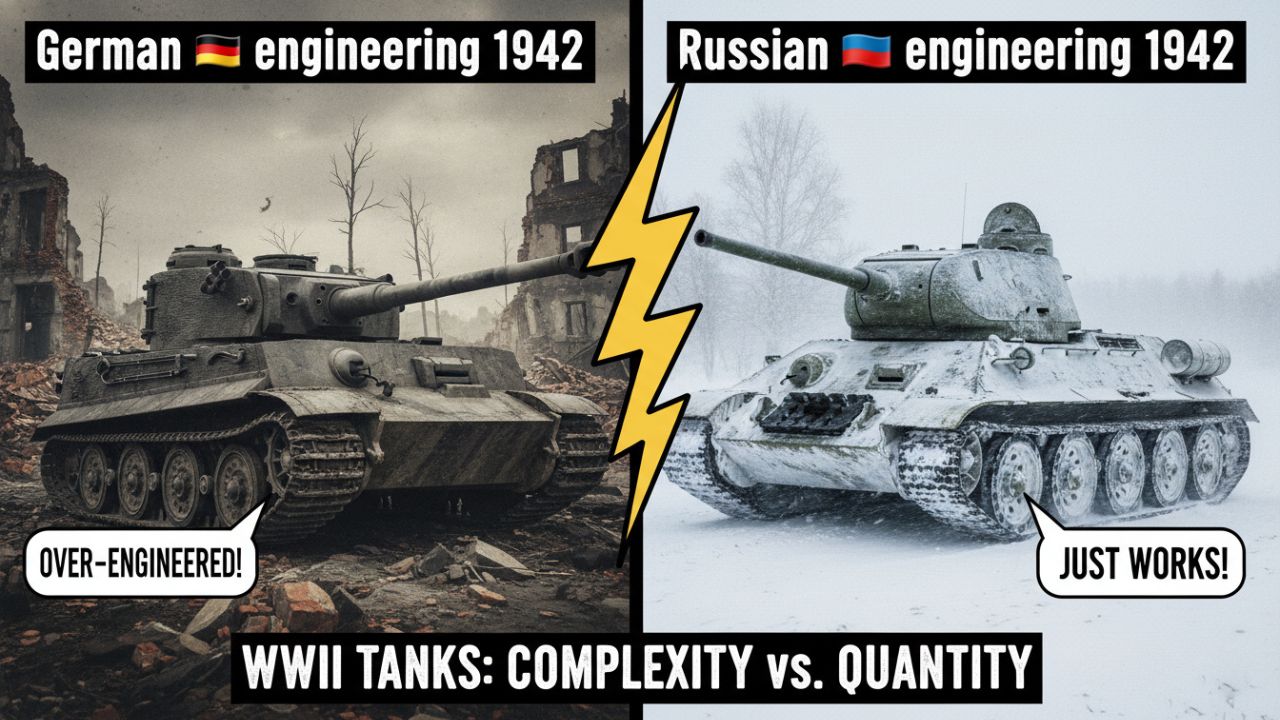
Have you ever built something so complicated that even you could not maintain it? Engineers in 1942 definitely did. That image of the heavy German Tiger 1 tank versus the practical Soviet T-34 is an example of overengineering, and a great way to start this conversation.
Just watched “T-34″ MOVIE and my mind is blown! The tank combat is incredible, and it got me thinking. This is a perfect metaphor for a huge problem in product development: overengineering.
It is not about national pride. It is about a familiar product question: when does engineering cross the line into overengineering?
What you will get from this post
- A clear definition of overengineering.
- Why product managers should care.
- A short real project story from plugin development.
- Practical rules to avoid overengineering.
- My thought process for finding pragmatic solutions.
What is overengineering?
Overengineering means designing a product or system that is more complicated, more expensive, or more capable than needed for the real goals. It is building with the intention to impress rather than to deliver value. Overengineering costs time, money, and focus. It produces fragile features, lower team morale, and slower delivery.
Simple example: adding an elaborate feature toggle system to manage a single tiny change. You get power you do not need, and complexity you will pay for forever.
Why product managers should care
Product decisions are resource decisions. Engineering is expensive. Every extra feature, every architectural “improvement,” and every minute spent polishing something that customers do not use is a missed opportunity. The question you must ask is not “Can we?” but “Should we?”
Good product managers help teams choose the right level of engineering. They balance risk, speed, customer value, and maintainability. Yes, elegant design matters. But elegance is only valuable when it helps deliver measurable outcomes.
Quick lesson from 1942
The meme you saw comparing a German heavy Tiger 1 tank and a Soviet T-34 is a compact lesson in design tradeoffs. The German tank was technically impressive. It was powerful. The US tank crew in “Fury” calls the Tiger 1 “THE BEAST.”

It required lots of resources and specialized maintenance. The T-34 was simpler but robust. It was easy to produce and repair. On the battlefield, the T-34’s practicality mattered more.
Think of the Tiger 1 as the ‘gold-plated’ feature set. It was designed to win any head-on battle (or in our terms, to impress in a single demo) with its unmatched gun and armor. But this came at a catastrophic cost to everything else: it was hard to build, and a nightmare to maintain.
The T-34, on the other hand, was the MVP. It didn’t win on every single spec sheet, but it was ‘good enough’ in its core functions like mobile, reliable, and easy to manufacture in huge numbers. This allowed the Soviet army to iterate and adapt quickly.
In product terms, building a Tiger 1 means you might have a technically impressive product, but you can’t scale it, your team can’t maintain it without unrealistic effort, and it delays your time-to-market. Building a T-34 means you ship a solid, reliable product that solves the core customer problem and can be improved upon over time.
Fast-forward to a modern development studio, and I watched this exact drama play out, not with tanks, but with code. Our “Tiger 1” was a WordPress plugin that lost its way.
The plugin that wanted to be everything
I was building a WordPress plugin for A/B testing sales pages. The initial brief was simple: track three metrics, run basic experiments, and show results. Then feature ideas started pouring in. Every stakeholder wanted a separate dashboard, advanced segmentation, multi-variant support, an integration with a dozen CRMs, and a visual editor with drag and drop.
I was tempted. Who would not want to ship a platform-level product? We started building. Weeks in, development slowed. Bugs multiplied. The visual editor required rewriting twice. The integration work created complex edge cases. Our maintenance backlog ballooned. The plugin was becoming a product that only a dedicated specialist could support.
So we stopped. We re-evaluated requirements. We reverted to the original mission: simple A/B experiments, reliable tracking, and an intuitive report. We postponed the other features to a roadmap and shipped a clean, focused MVP. Adoption climbed. Support tickets dropped. The team regained momentum.
Lesson: adding features without a clear, prioritized customer need led to technical debt and delayed value delivery.
Practical rules to avoid overengineering
Here are concrete guardrails you can use as a product manager.
- Define success metrics first.
Every feature must map to measurable outcomes. If it does not, do not build it now. - Prefer the smallest experiment that answers the biggest question.
Build the minimal change that proves whether customers care. - Ask “how will we maintain this?” before design sign-off.
If support requires specialized skills or long training, rethink. - Use the “cost to change” lens.
If a design is expensive to modify later, make it simpler. - Timebox exploratory work.
Allow short spikes, then convert findings into minimal deliverables. - Defer polish until product-market fit.
Invest in reliability and observability before UI flair. - Keep teams cross-functional and aligned on tradeoffs.
Product, design, and engineering must agree on the acceptable level of quality. - Document intentionally.
Good docs are cheap insurance against complexity.
How to measure whether complexity is helping or hurting
Use these signals.
Positive signals
- Faster user adoption.
- Clear reductions in customer effort.
- Lower support load.
Negative signals
- Longer release cycles.
- Frequent regressions or fragile tests.
- Rising maintenance costs per feature.
If negative signals appear, re-evaluate the architecture and the roadmap. Complexity that does not produce measurable benefits is waste.
How I approach solutions
Here is the method I used on the plugin project and use regularly. You can copy it.
- Clarify the mission. What is the single problem we must solve?
- Define one or two success metrics. How will we know we succeeded?
- Sketch the minimal flow that delivers those metrics. Keep sketches quick.
- Identify risks and unknowns. Prioritize experiments to reduce the biggest risks first.
- Build the experiment with limited scope and clear roll-back plan.
- Measure, learn, and iterate. If metrics are positive, expand incrementally.
- Stop building features that do not move metrics. Reallocate effort.
This process keeps engineering aligned with value. It converts opinions into small tests and evidence.
My short checklist for decision reviews
Use this before approving a new feature:
- What problem does this solve? (One sentence)
- What metric will change? (Name and target)
- Who will maintain it? (Role)
- How long will it take to build and support? (Rough estimate)
- What is the rollback plan?
- Is this reversible? If not, why?
If you cannot answer these quickly, do not greenlight full development. Start with a spike or prototype.
Takeaway
Build what matters first. Simplicity scales better than complexity. If your team can maintain and iterate quickly, you win. Overengineering is an expensive status symbol.
A personal note
I used to think complexity proved competence. Today I believe competence shows in outcomes. The recent project taught me to prefer clarity over cleverness. The most valuable features are the ones customers use and the team can support.
If you want practical frameworks to manage risk and avoid overengineering, check my Risk Management course at www.whatisscrum.org. It will teach you how to spot hidden risk, prioritize what to build, and make your engineering predictable. Use code IWANTTHIS for 10 percent off.
