The #1 Reason Your Project Risks Feel So Overwhelming on Monday
Do you remember the news from July 19, 2024? A software update crashed 8.5 million computers in 78 minutes. It stranded 1.3 million Delta passengers and took 911 call centers offline. The damage totaled ten billion dollars. That disaster began as a single unmanaged project risk. It is the same type of risk that threatens your projects every Monday morning.
Someone at CrowdStrike probably thought, “What if this breaks everything?” But that worry stayed in their head. Never written down and never prioritized. I just wanted to let you know that I never acted on.
Now think about your Monday morning. Coffee in hand, laptop open. But there’s that knot in your stomach.
What if the vendor is late? What if your developer quits? What if the client changes the scope? The worries pile up and steal your focus.
Here’s what I learned: that overwhelming feeling isn’t a sign you’re bad at your job. It’s a sign you’re managing risk in your head instead of on paper.
Your Brain Wasn’t Built for This
I once spent three months worrying about a database migration on a government project. Every Sunday night, I’d sit in my dark office trying to imagine everything that could go wrong.
I thought if I just concentrated hard enough, I could predict every problem.
The migration went fine. But a completely different risk I’d barely thought about hit us hard: our technical writer quit two weeks before a regulatory deadline. We scrambled, missed the deadline, and paid a 40,000 dollar penalty.
I’d been so busy obsessing over one risk in my head that I missed the one that actually mattered.
Your brain can only hold 4 to 7 things in working memory at once. But a typical project has dozens of potential risks. You can’t win by thinking harder.
And here’s what the billion dollar disasters teach us: it’s not about project size. CrowdStrike, Boeing, Southwest all had smart people and big budgets. But their risks still escaped because someone kept them in their head instead of in a system.
Why Traditional Solutions Don’t Work
Maybe you’ve tried lists. I had risks on sticky notes, in random documents, buried in meeting notes. Risks everywhere and nowhere.
Or those formal risk meetings where everyone fills out a risk register nobody checks until next quarter. Box checked. Problem not solved.
Southwest Airlines learned this the hard way. Their pilots union warned them in November 2022: “We’re one router failure away from complete meltdown.”
One month later, Winter Storm Elliott hit. Their 30 year old scheduling system couldn’t track where pilots and flight attendants were located. They canceled 16,700 flights. Stranded 2 million people at Christmas. Cost: 825 million dollars.
The risk was known. The warning was explicit. But it lived in someone’s brain instead of in a system that demanded action.
Most advice makes it worse:
- “Do a thorough risk assessment!” Now you have 93 risks and no idea which ones matter.
- “Be proactive!” Great. HOW? Where do you start when everything feels urgent?
- “Stay calm!” Super helpful when your budget just got cut by 20%.
My Breakthrough (The Risk Jar)
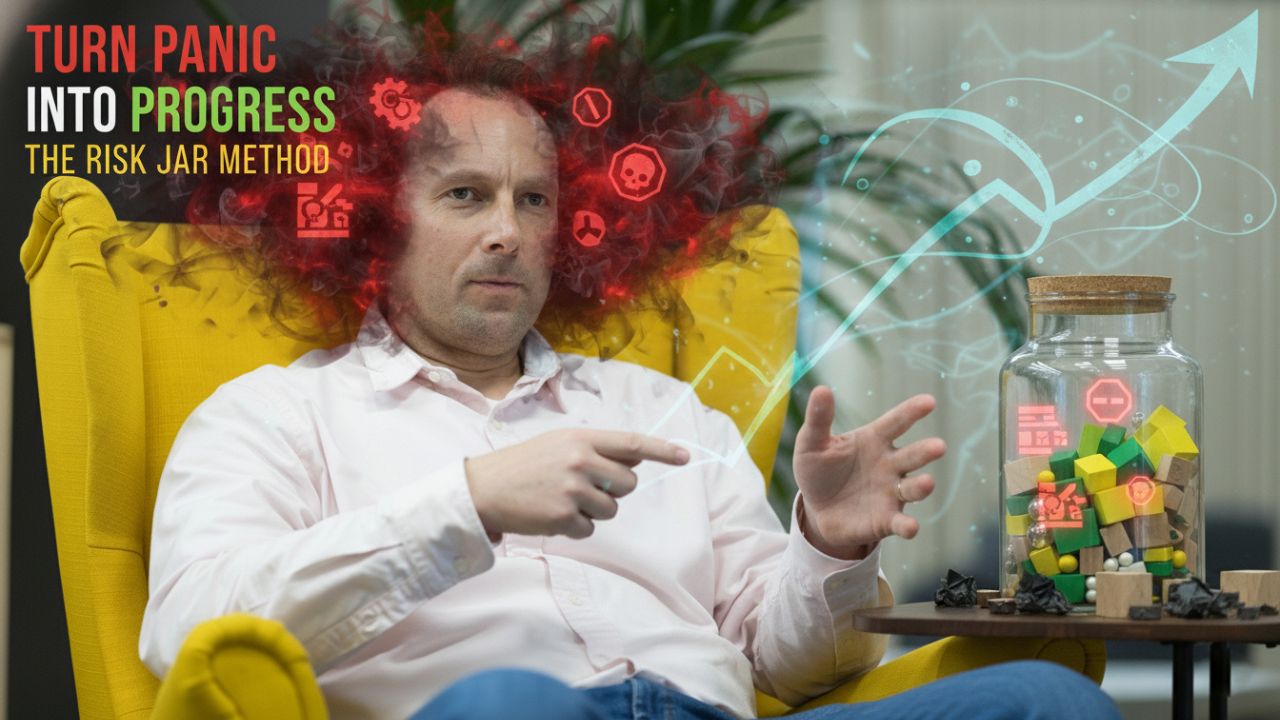
My daughter’s school counselor taught her to write worries on paper and put them in a jar. The act of capturing them helped her brain let go.
I thought: if this works for a seven year old, why not for project risks?
I grabbed a coffee jar. Every risk that popped into my head went on a sticky note and into the jar. Vendor delays. Budget approvals. Training needs. Vacation conflicts. Everything.
Within two days, the knot in my stomach eased.
I wasn’t ignoring the risks. I was getting them out of my head into a place where I could see them and deal with them later. The jar became a mental release valve.
But the jar was just the starting point. A jar full of sticky notes isn’t a strategy. That’s where the real work began.
From Chaos to Control
I dumped the jar on my desk. Some risks were huge. Some tiny. Some I could control. Others were outside my influence.
Here’s what Boeing forgot: identifying risks isn’t enough. You have to prioritize them and act on them.
In January 2024, a door panel blew off a Boeing 737 at 16,000 feet. Four critical bolts were never installed. An FAA audit showed Boeing failed 37% of product inspections. Employees were afraid to raise safety concerns.
They knew. The risks were written down. But not prioritized. Not acted on. Documentation without action is expensive paperwork.
I started grouping my risks with concrete examples:
- High impact, likely to happen: “Our lead developer mentioned looking at other jobs.” Watch closely.
- High impact, unlikely: “The data center could lose power.” Needs a backup plan, but not daily stress.
- Low impact, likely: “Client always asks for minor tweaks in reviews.” Handle quickly.
- Low impact, unlikely: “Vendor might send wrong hardware model.” Bottom of the pile.
By day 10, my jar had 23 risks. Turned out 6 were duplicates. Eight were already handled. That left 9 real risks. Only 3 needed immediate action. Suddenly manageable.
For the first time in months, I felt in control instead of controlled by anxiety.
This simple system worked whether I was managing waterfall projects with phase gates or running two week sprints. The risks are the same. The overwhelm is the same. The relief of getting them out of your head is the same.
The Pattern That Should Scare You
Look at the last two years:
- CrowdStrike didn’t test their update. 8.5 million computers crashed. 10 billion dollars.
- Boeing didn’t act on documented quality problems. A door fell off. 36 billion dollars in losses.
- Southwest ignored explicit IT warnings. Two million stranded at Christmas. 825 million dollars.
Every disaster started with a “what if” that someone thought about but never captured, prioritized, and addressed systematically.
Your project won’t crash 8.5 million computers. But that unmanaged risk you’re worried about? It could blow your deadline, destroy your budget, or tank your reputation. My ignored 40,000 dollar risk taught me that.
The difference between you and them? You’re reading this. You’re looking for a better way.
The Science Behind Why This Works
When risks stay in your head, your brain treats them like active threats. Your stress response stays on. You’re constantly scanning for danger.
When you write a risk down and put it somewhere safe, your brain gets a signal: “Okay, this is handled. We can deal with it later.” Your stress response can take a break.
Psychologists call this “cognitive offloading.” One study found that people who wrote down their worries before a stressful task performed significantly better. The act of externalizing anxiety freed up mental energy for actual problem solving.
That’s what the Risk Jar does. It turns the invisible, swirling cloud of anxiety into a visible, manageable list.
What You Can Do Right Now
No fancy software needed. No certification. No permission from your boss.
- Get a container. Jar, box, folder. Make it physical if you can.
- For one week, capture every risk that pops into your head. Don’t judge. Don’t analyze. Just write it down and put it in.
- Dump everything out at week’s end. You’ll be surprised. Some risks appear three times. Some aren’t risks at all. Some are the same risk in different hats.
- Sort into four piles using the examples above. High impact and likely. High impact but unlikely. Low impact and likely. Low impact and unlikely.
- Focus on the top pile first. These deserve your attention. The rest can wait.
That’s it. First step from overwhelmed to in control.
The Next Level
The Risk Jar was transformational, but just the beginning.
After a few weeks, I needed more. I needed to track which risks were getting better or worse. Assign owners. Integrate this into how my team actually worked, whether in sprint planning or phase gate reviews.
That’s when I built a complete system.
Think about CrowdStrike, Boeing, and Southwest. Smart people. Big budgets. Formal processes. But their risks still escaped and caused catastrophic damage.
Why? Because identifying risks isn’t enough. You need a system that forces you to prioritize them, track them, and act on them before they become disasters.
In my course, Risk Management in Scrum, I walk you through the complete system. You’ll learn how to prioritize risks with your team, integrate risk discussions into existing meetings without overhead, and build confidence you’re managing what matters.
But here’s what I want you to know: whether you take the course or not, you can start today with a jar and sticky notes.
The overwhelm isn’t permanent. It’s not a flaw. It’s a sign you need to get the risks out of your head and into a system.
CrowdStrike crashed 8.5 million computers because someone’s “what if” stayed in their head. Southwest stranded 2 million passengers because warnings stayed in meeting notes. Boeing’s door fell off because documented problems never became action.
Don’t let your project become the next cautionary tale.
Start with the jar. Capture instead of carry.
Your Mondays will feel lighter.
Ready to take risk management to the next level? The disasters of 2024 proved what happens when risks stay in people’s heads. Make sure yours don’t. Explore Risk Management in Scrum and transform anxiety into action.
