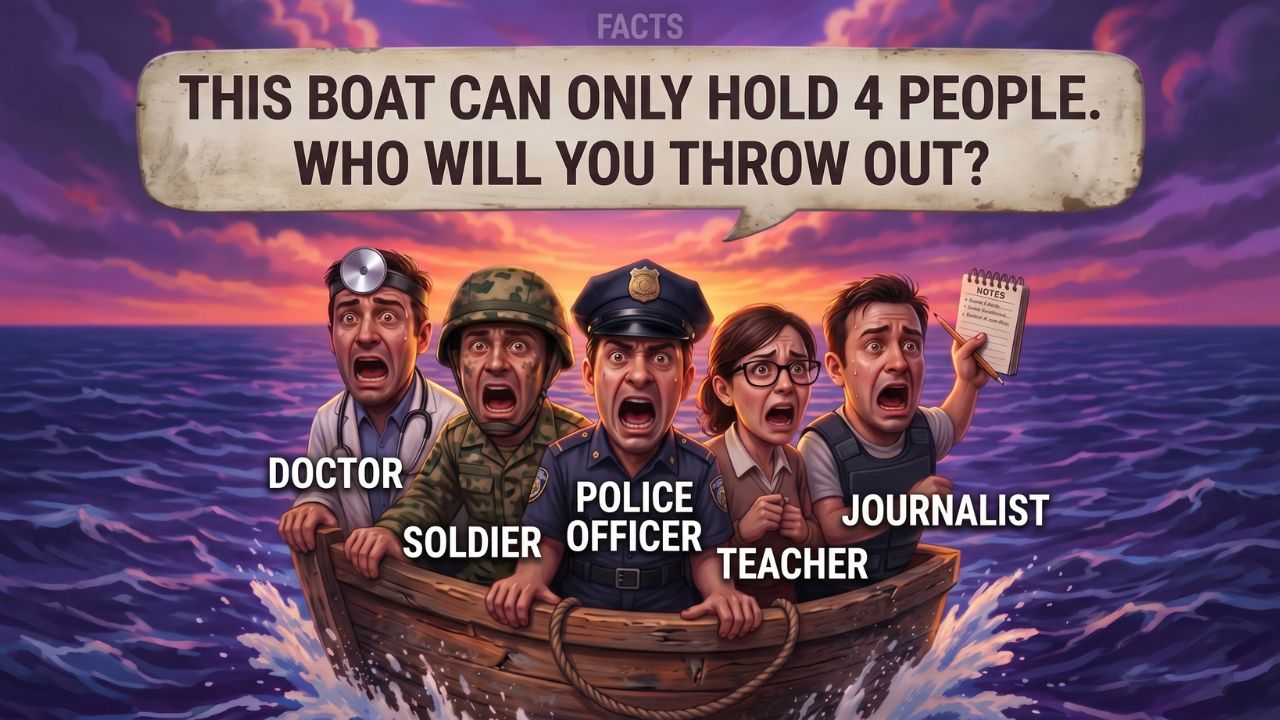
The Lifeboat Test (The boat only holds 4. Who do you throw out?)
Let’s perform a lifeboat test together: The boat only holds 4. Who do you throw out?
You have probably seen the picture. A small wooden boat in a stormy sea. Five people crammed inside, all screaming. A doctor, a soldier, a police officer, a teacher, and a journalist. Above them, one cold question:
“This boat can only hold 4 people. Who will you throw out?”
It is a great hook. It pulls you in fast, and it almost forces you to answer.
So let us play it straight.
Pause here. Pick one.
Before you read another word, choose. Out of those five people, who goes into the water?
Do not skip this part. Say the name in your head right now, and notice how fast it comes to you. Notice that you did not really need to think. The answer just arrived.
Hold on to that name. We are going to come back to it.
The Answer Most Give on This Lifeboat Test
When this meme spreads online, one answer shows up more than any other: the journalist.
The reasoning is usually emotional, not logical. A lot of people simply do not trust the media anymore. They see modern journalism as biased, loud, or driven by clicks instead of truth. So the journalist feels like the easy one to lose.
The other four feel useful in a way you can touch. The doctor heals. The soldier protects. The officer keeps order. The teacher passes on knowledge. Information, in a crisis, feels like a luxury.
That is the trap the picture is built on. It rewards a snap judgment and calls it common sense.
Let us slow it down.
Now change one thing
Imagine these five are not random strangers. Imagine they are the last people left on the planet. No rescue coming. Just five humans who have to survive the next weeks and months together.
Now think about what this group actually faces. Injuries, sickness, hunger, exhaustion, heavy physical work, and tense decisions made under stress.
Notice that every person on that boat still matters. The doctor keeps people alive. The teacher passes on skills the group desperately needs. The soldier brings strength, discipline, and real survival ability. The officer brings something easy to overlook: the skill to calm conflict and hold a frightened group together when things get ugly.
So far, nobody is obviously useless. But here is the thing. A brand new need just appeared on the list, one that the meme never asks you to think about.
The skill the meme forgets
In a group with no records and no history, someone has to write things down.
Where the clean water is. Which plants are safe to eat? What the weather does. Which decisions worked and which ones failed? What the doctor learned about a sickness, so the next person does not die from the same thing.
That is documentation. And documentation from day one is not a nice extra. It is how a small group stops repeating fatal mistakes. It is the library that future people, or your own children, will one day depend on.
Now, you might not trust modern media, and that is a fair conversation to have. But set the reputation aside for a second and look at the underlying skill: observing carefully and recording clearly so that knowledge survives. That is the journalist’s craft.
The role the meme treats as the easy one to drop turns out to carry a skill no one else on the boat was trained for. The “obvious” rejection is not so obvious anymore.
If that gives your first answer a little wobble, good. That feeling is the whole point.
Why this is really a team problem
Here is where it gets interesting for anyone who builds teams for a living.
The meme asks the wrong question. “Who is least important?” sounds smart, but it leads you straight into bias and guesswork. It treats people as fixed job titles instead of a group trying to reach a goal.
Anyone with real Scrum experience would not answer that question at all. They would replace it with a better one:
“What kind of team do we need to survive and stay alive long term, with the limited capacity we have?”
That single change in the question changes everything. Let me show you how.
1. A cross-functional team beats five specialists
In Scrum, you do not build a team of five experts who each guard their own task. You build a team that together covers every skill the goal needs.
Survival here calls for medical care, practical skills, knowledge sharing, conflict handling, and record keeping. No single person owns all of that. But several of them can stretch into more than one area. You stop asking “what is your title” and start asking “what can this group do together.”
2. Value depends on the current goal
In Scrum, value is not fixed. It is measured against the goal of right now.
In the first two weeks, the goal is simple: do not die, and set up a base. The doctor and the soldier shine here, one for health and one for raw capability and survival skills.
After a month, the goal shifts toward staying alive long term and passing on what you know. Now the teacher and the documentation work climb in value. Knowledge that is taught and written down becomes the thing that keeps the group going.
Same people. Different value. Because the goal moved.
3. The best players are multipliers
Scrum teams love T-shaped people. Deep in one skill, but able to help in others.
The teacher is the strongest multiplier on this boat. Teach one person to make fire, and now two people can. Recording knowledge multiplies in a different way. By writing things down, the group keeps what it learns even after someone forgets or dies. Multipliers do not just do work. They make everyone else more capable.
4. The roles roughly map (but do not take this too literally)
Here is a fun one, with a warning attached: this is a loose analogy, not a precise fit. Do not read it as official Scrum role definitions, because the real roles are more specific than this.
If you squint at the group through a Scrum lens, the teacher acts like a coach who lifts everyone around them. The officer plays a Scrum Master kind of part, protecting the group’s focus and smoothing out conflict. The doctor and the soldier are like developers with critical, hands-on skills. And whoever keeps the records becomes the team’s knowledge keeper, making sure nothing the group learns gets lost.
The exact labels matter far less than the point underneath them. Different skills become valuable at different moments, and a healthy team needs more than raw expertise.
5. Every team storms before it performs
New teams move through stages: forming, storming, norming, performing. Five scared strangers on a boat would hit the storming stage fast. Arguments over food, over decisions, over who does what.
The people who can move a group from chaos to calm, through clear rules, honest communication, and good records, become priceless. Not because of their job title. Because of what they do for the team.
What you never actually knew
Here is the part that should stay with you.
You answered the question at the very start. But look at everything you never actually knew.
You did not know whether the soldier was trained for survival or only for combat. You did not know whether the doctor was any good at the job. You did not know whether the teacher could actually teach, or whether the journalist could document anything useful at all. You had no real information about any of them as people. You had only their labels.
And yet most readers picked someone in under five seconds.
That is exactly how a lot of organizations build teams. They hire labels. They manage titles. They judge resumes. And then they wonder why the team keeps struggling.
The best leaders do not evaluate people that way. They evaluate the whole system: the goal in front of them, the skills that are missing, and how the pieces actually fit together. That is a learnable skill, and it sits at the heart of how strong Scrum teams work.
Learn to think this way on purpose
If this little exercise made you notice how often teams get judged by job titles instead of outcomes, that is exactly the mindset shift I teach inside the Scrum Career Accelerator.
Inside the program, you will learn how to:
- build cross-functional teams that cover every skill the goal needs
- spot the capability your team is actually missing
- prioritize value as the goal keeps changing
- lead a team without leaning on hierarchy
For just $47, you get the complete program. Through July 31, 2026, it also includes my new AI-Powered Backlog Refiner course as a free bonus.
Get the complete program for $47 here
And that name you picked back at the start, before you knew a single real thing about any of them? Maybe the better question was never who to throw out. It was what the team actually needed to survive.
