What Are the Core Agile Competencies?
What Are the Core Agile Competencies?
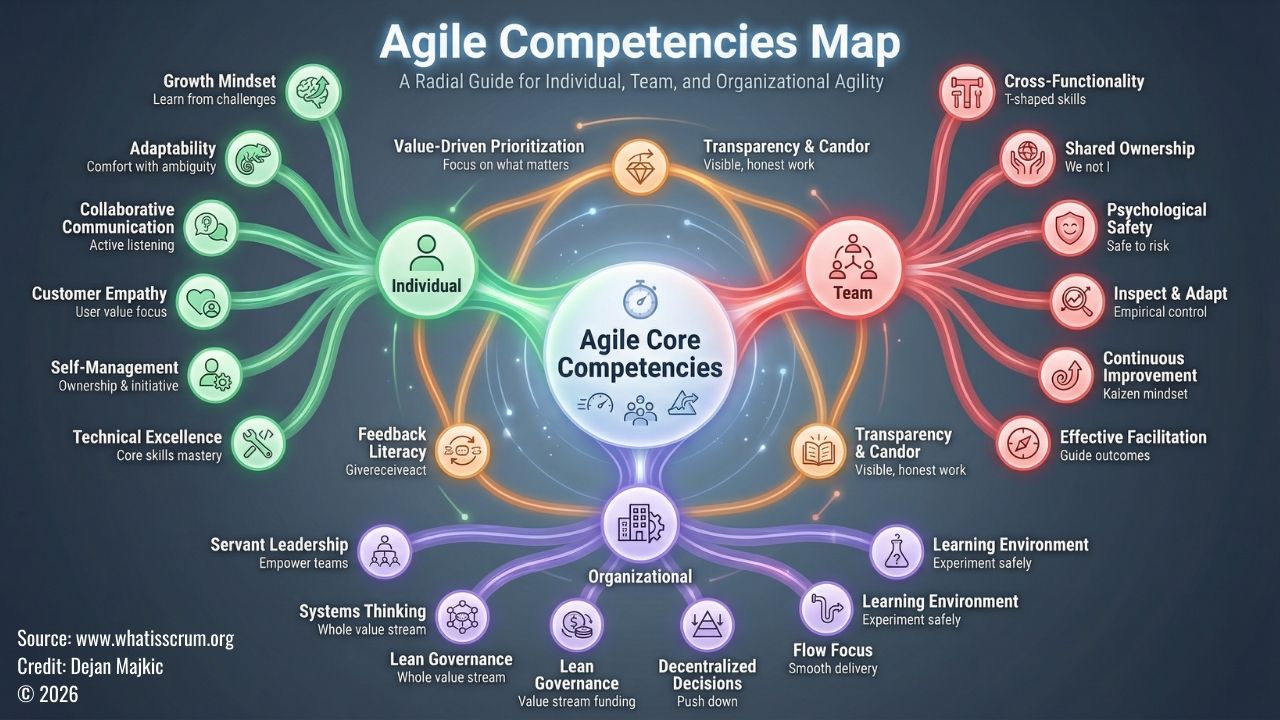
That’s a great question. The idea of core agile competencies goes beyond just sticking to practices like Scrum events. It’s really about the mindsets, skills, and abilities that let people and teams truly embrace agility. These are the key elements for thriving in a fast-paced, unpredictable world.
We can think of them across three main levels: individual, team, and organizational.
Download Your Free Agile Competency Map Poster (2750 x 1536 px, 6.2 MB PNG)
Individual Core Competencies
These are the personal skills and mindset every agile practitioner should have.
- A Growth Mindset is essential. It’s the belief that you can build your abilities through effort and dedication. You embrace challenges, learn from feedback, and see hard work as the way to get better.
- Adaptability and Comfort with Ambiguity. This means you can shift directions based on new info or feedback without getting stuck in uncertainty.
- Collaborative Communication is huge too. It involves active listening, expressing ideas clearly, and having productive conversations. You’re good at facilitating discussions and sorting out conflicts.
- Customer-Centricity and Empathy come next. It’s all about focusing on what the end-user needs and delivering real value, while seeing things from their point of view.
- Self-Management and Ownership mean taking initiative, handling your own tasks, and being accountable for results without someone hovering over you.
- And don’t forget Technical or Functional Excellence. That’s having strong skills in your main area, whether it’s development, testing, design, or product management, so you can produce high-quality, sustainable work.
Team Core Competencies
These are what make a high-performing agile team tick.
- Cross-Functionality and T-Shaped Skills are key. Team members have their specialties, but they also have broader abilities to pitch in elsewhere, which helps avoid bottlenecks.
- Shared Ownership and a “We, Not I” Mentality mean the whole team takes responsibility for the product, process, and results. Wins and setbacks are collective.
- Transparent Communication and Psychological Safety let everyone feel secure enough to take risks, share opinions, admit errors, and ask for help without worrying about judgment.
- Empirical Process Control is about inspecting and adapting based on actual data, like working software, metrics, or feedback, instead of clinging to a fixed plan.
- Continuous Improvement (Kaizen) is the habit of regularly reflecting on and tweaking your processes, tools, and ways of working together.
- Effective Facilitation means team members, not just the Scrum Master, can guide meetings and talks to get real results.
Organizational Core Competencies
These are what leaders and the wider company need to support agile teams.
- Servant Leadership is about leaders clearing obstacles, providing resources, coaching, and empowering teams, rather than dictating everything.
- Systems Thinking helps everyone see how team work connects to the bigger picture and company goals, optimizing the entire system instead of just isolated parts.
- Lean-Agile Governance and Funding shift away from project-based or yearly budgets to steadily funding value streams and teams, maybe using things like OKRs or lean budgeting.
- Decentralized Decision-Making pushes choices down to the people closest to the work for faster, more relevant outcomes.
- A Focus on Flow and Delivery prioritizes smooth, quick, sustainable value to customers over just keeping busy, tracked by metrics like cycle time and throughput.
- Creating an Environment for Learning encourages trying new things, viewing smart failures as chances to grow, and investing in people’s development.
Overarching Meta-Competencies
There are also some overarching meta-competencies that apply at every level.
- Value-Driven Prioritization is the ongoing practice of asking what’s the most valuable thing to do right now, and having the guts to say no or not yet.
- Feedback Literacy means being skilled at giving, receiving, and acting on feedback everywhere, from code reviews to product demos to strategy talks.
- Transparency and Radical Candor involve making work, progress, issues, and data visible to everyone, while communicating directly and with genuine care.
Why These Agile Competencies Matter
Why do these competencies matter more than the practices themselves? You could set up standups, sprints, and boards (the mechanics) but without these foundations, it’s just agile in name only. It turns into a stiff, ritual-heavy process that doesn’t deliver the speed, flexibility, or innovation you’re after.
Building these Agile competencies is an ongoing journey, not a quick workshop. They grow through steady practice, reflection, coaching, and support from leaders.
If you’re ready to dive in, check out the competencies that have helped over 14,000 students land jobs at Microsoft, Google, and Amazon at www.whatisscrum.org.
