A Digital Course Bundle, Spelled Out
No physical product is shipped. Everything is delivered online.
-
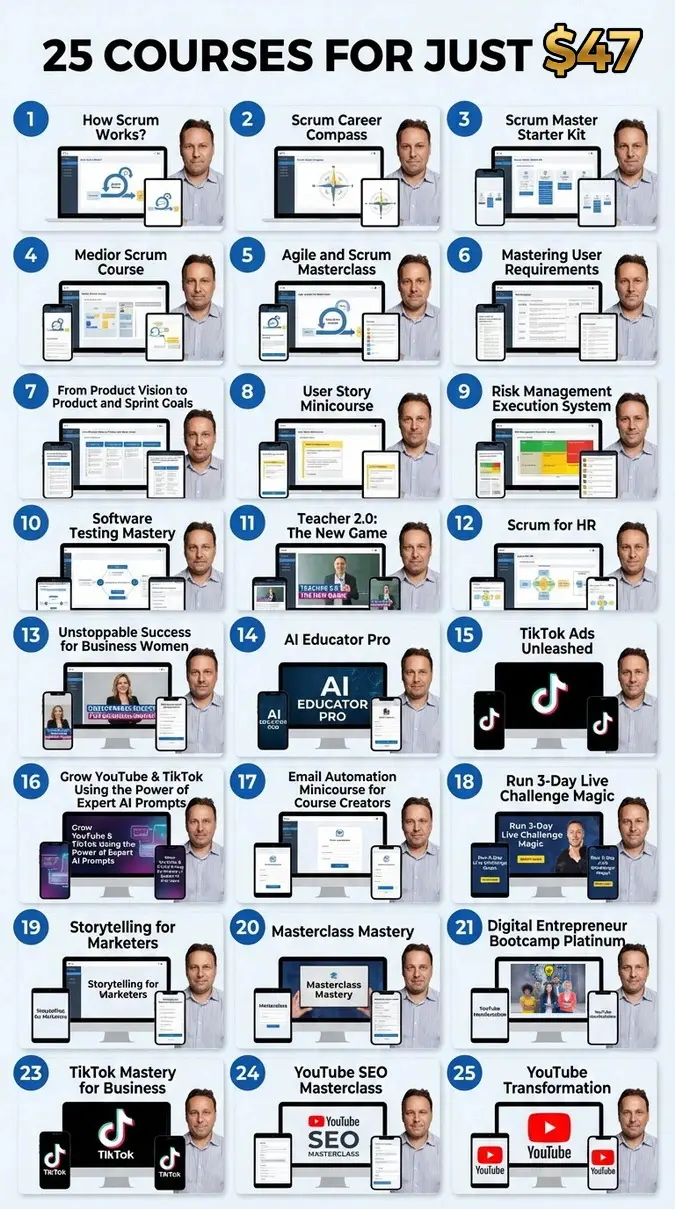
Scrum & Agile video courses Agile and Scrum Masterclass (29 hours), User Story Mastery, Software Testing, Risk Management, PSM I Exam Walkthrough and more. See all 12 by name12 courses
-
Bonus Scrum courses AI-Powered Backlog Refiner (C.R.A.F.T. framework) and Retro Results (13 retrospective templates)2 courses
-
Career, marketing & consulting video courses Practical skills for freelancing, consulting, and sharing your expertise online. See all 13 by name13 courses
-
Templates and career tools Downloadable inside the courses: sprint plans, retrospectives, user stories, risk assessments, resume and interview prepIncluded
-
Certificates of completion One for every course you finish. Not an official PSM or PSPO certification, and the official exam fee is not included.Included
-
Delivery After payment you are enrolled on Thinkific and receive your login by email, usually within minutes. Watch on any device.Digital
-
Refund Full refund within 60 days of purchase, for any reason60 days
One-time payment • No subscription • 60-day refund
See What's Inside the Bundle
A 2-minute overview of the courses and how the three paths work
14,000+ bundle students • Digital access via Thinkific • 60-day refund

All 25 Courses. Pick Where You Start.
This is one 25-course library with three common starting points, not three products. Pick the one that matches your life today. You get access to the full library from day one either way.
The Career Changer's Path
You come from teaching, retail, admin, or anywhere except tech. Learn Scrum from zero and prepare for your first Scrum Master or Product Owner role.
Breaking into Scrum from another fieldThe Drafted Pro's Path
Your company adopted Agile without asking you. Learn the vocabulary and the mental model so you can actually contribute.
Non-Scrum roles inside Agile teamsThe Practicing Pro's Path
You have 1 to 5 years as a Scrum Master, PO, or BA. Learn the senior-level frameworks that make your impact visible to leadership.
Working SMs, POs, and BAsThis isn't for you if…
- You expect the official certification exam fee included. This is prep, not the exam itself.
- You are not willing to put in a few focused hours a week.
- You need live 1:1 coaching or a scheduled cohort. Every course here is self-paced video.
"Why Is This Only $47?"
Honest answer: I have a full-time job leading IT, and I have for more than 20 years. Course sales are not my main income.
That lets me price for reach instead of margin. The people I most want to help are career changers, beginners, and professionals pivoting into Scrum, and a high price would shut many of them out.
More students at a low price works better for me than a few students at a high price. That's the entire catch.

Everything Inside the Bundle
12 Scrum and Agile courses and 13 career, marketing and consulting courses, plus 2 bonus Scrum courses. Full list below.
Ready-to-Use Templates
Sprint plans, retrospectives, user stories, risk assessments
Career Toolkit
Resume templates, interview prep, LinkedIn guidance
PSM I Exam Prep
A full 80-question PSM I walkthrough plus certification prep in the Masterclass
Student Community
Access to the Agile and Scrum Masterclass Facebook group
The 12 Scrum & Agile Courses
Two more Scrum courses come as bonuses with every order: the AI-Powered Backlog Refiner and Retro Results. That makes 14 Scrum courses in total.
- Agile and Scrum MasterclassThe flagship 29-hour deep dive: full Scrum framework, roles, events, artifacts, and certification prep. Several shorter courses below touch on topics it also covers, in less depth.
- Scrum Master Starter KitA quick-start orientation to Scrum terms, roles, and a self-assessment checklist. Your first stop if you're brand new.
- Scrum for Non-Technical TeamsScrum roles, meetings, and artifacts translated for marketing, HR, and operations. No code, no jargon.
- Scrum Career CompassA 7-day self-assessment to figure out which Scrum career path fits you and build a roadmap toward it.
- Mastering User RequirementsHow to gather, write, and prioritize user requirements. Includes the Goalcraft in Scrum lesson on product and sprint goals as a bonus module.
- User Story MasteryWriting, splitting, and mapping user stories, including acceptance criteria and story-mapping techniques.
- Handle Difficult People in ScrumA 5-step framework and specific tactics for handling pushback and conflict without formal authority.
- Risk Management EXECUTION SystemIdentifying, assessing, and mitigating risk inside Scrum events, with a two-level risk management approach.
- Software Testing MasteryQA fundamentals through advanced Agile testing strategy: the testing mindset, automation, and security testing.
- Agile HR Mastery (Scrum for HR)Applying Scrum to recruitment, onboarding, and performance management for HR and operations teams.
- Medior Scrum CourseScrum fundamentals plus applying Agile to business growth, built for career switchers moving into Scrum.
- PSM I Exam WalkthroughA real 80-question PSM I exam session you can pause and test yourself against before booking the actual exam.

Real Students, Real Results
Career Changers who got hired. Practicing Pros who went independent. Different paths, same bundle.

"I landed my Scrum Master role at a Fortune 500 company just 6 weeks after completing Phase 1. The interview prep templates were exactly what I needed."

"Passed my PSM I certification on the first attempt with 95%. The exam prep course in Phase 2 covered every question type I saw on the real test."

"Zero tech background to Product Owner in 3 months. The User Story Mastery course taught me frameworks my colleagues still don't know. Best investment I ever made."

"Used Phase 3 to launch my Agile consulting business. [...] The marketing courses were pure gold."
Are you a Drafted Pro who found your footing with this bundle? Email me your story.
Pass rate, rating, and review count come from student reviews of my courses on Udemy. "Phase 1, 2, 3" in some reviews is the earlier name for the learning paths. Quotes are unedited except where marked [...]. Individual results vary: the testimonials above are among our students' strongest outcomes, not typical or guaranteed results.
Who's Behind This?
MSc in Computer Science
20+ Years in IT Leadership
70+ Scrum and Product Owner Certifications
140,000+ Students Across My 35+ Courses
"I created this bundle because I remember how confusing and expensive it was to learn Scrum properly, with courses that promised everything but delivered little you could actually use.
After 20 years leading IT teams, I've learned that people don't need more theory, they need frameworks and systems they can use Monday morning.
This bundle puts everything I teach in one place at a price most people can afford. If one template helps you land a job or save a project, I've done my job."
Dejan Majkic

4 Bonuses in the $47 Price
Every order includes all four. There is no upgrade to buy.
AI-Powered Backlog Refiner Course
The C.R.A.F.T. framework for turning a vague stakeholder request into a sprint-ready user story.
Retro Results Course
13 done-for-you templates that turn retro action items into results before they stall.
Certificates of Completion
One for every course you finish. Add them to LinkedIn and your resume.
Private Group Support
Questions about the course content? Ask them in the private student group.
Your Order
Scrum Career Accelerator • Digital product • One-time payment
Price:
One-time payment • No subscription
 Full refund within 60 days of purchase, for any reason
Digital product, delivered by email via Thinkific. No physical shipment. Payment is processed securely by Ko-fi.
Secure checkout via Ko-fi
What Happens After You Click:
60-Day Refund, Any Reason
If the bundle isn't right for you, you get a full refund within 60 days of purchase. No conditions and no minimum or maximum viewing requirement.
How it works:
Request your refund within 60 days of purchase using the contact details in the Refund Policy. I refund the full amount to your original payment method.
No catches. No clauses. Your call.

Frequently Asked Questions
A digital product: access to 25 self-paced online video courses on the Thinkific course platform. That is 12 Scrum and Agile courses and 13 career, marketing and consulting courses, plus 2 bonus Scrum courses (AI-Powered Backlog Refiner and Retro Results) and certificates of completion for every course you finish. Nothing physical is shipped. The price is $47, paid once.
No prior experience? The Career Changer path starts from "What is Scrum?" and takes about 4 to 6 weeks. Already sitting in Scrum meetings because your company adopted Agile? The Drafted Pro path takes about 3 to 4 weeks. Already working as a Scrum Master, PO, or BA with 1 to 5 years in the role? The Practicing Pro path skips the fundamentals and takes 6 to 8 weeks. All three paths use the same 25-course library, so switching paths costs nothing extra.
No catch. I have a full-time job leading IT, so course sales are not my main income. That lets me price for reach instead of margin: more students at a low price works better for me than a few students at a high price.
That's fine. The 12 Scrum and Agile courses plus the 2 bonus Scrum courses are the heart of this bundle. The 13 career, marketing and consulting courses are included for anyone who wants to freelance or consult later. Skip them if they're not relevant to you.
Yes, a certificate of completion for every course you finish is included. You can add them to your LinkedIn profile and resume. They are not official certifications like PSM or PSPO, and the official exam fee is not included.
60 days, for any reason. To request a refund within 60 days of purchase, use the contact details in the Refund Policy and I will refund the full amount to your original payment method.
When you click "Buy Now", you go to a secure Ko-fi checkout where you can pay by card, PayPal or Apple Pay. After payment you are enrolled on the Thinkific course platform, usually within minutes, and you receive an email with your login details. If you do not see it, check your spam folder or email dejan@whatisscrum.org.
P.S.
BONUS The AI-Powered Backlog Refiner course is included with every order, together with the 12 Scrum courses, the 13 career and marketing courses, Retro Results, and certificates of completion. All 25 courses plus both bonus courses for $47, paid once.
Digital product • Access via Thinkific, usually within minutes • 60-day refund